RPA Finance
Transforming Finance Operations into Privacy-First, High-Velocity Automation.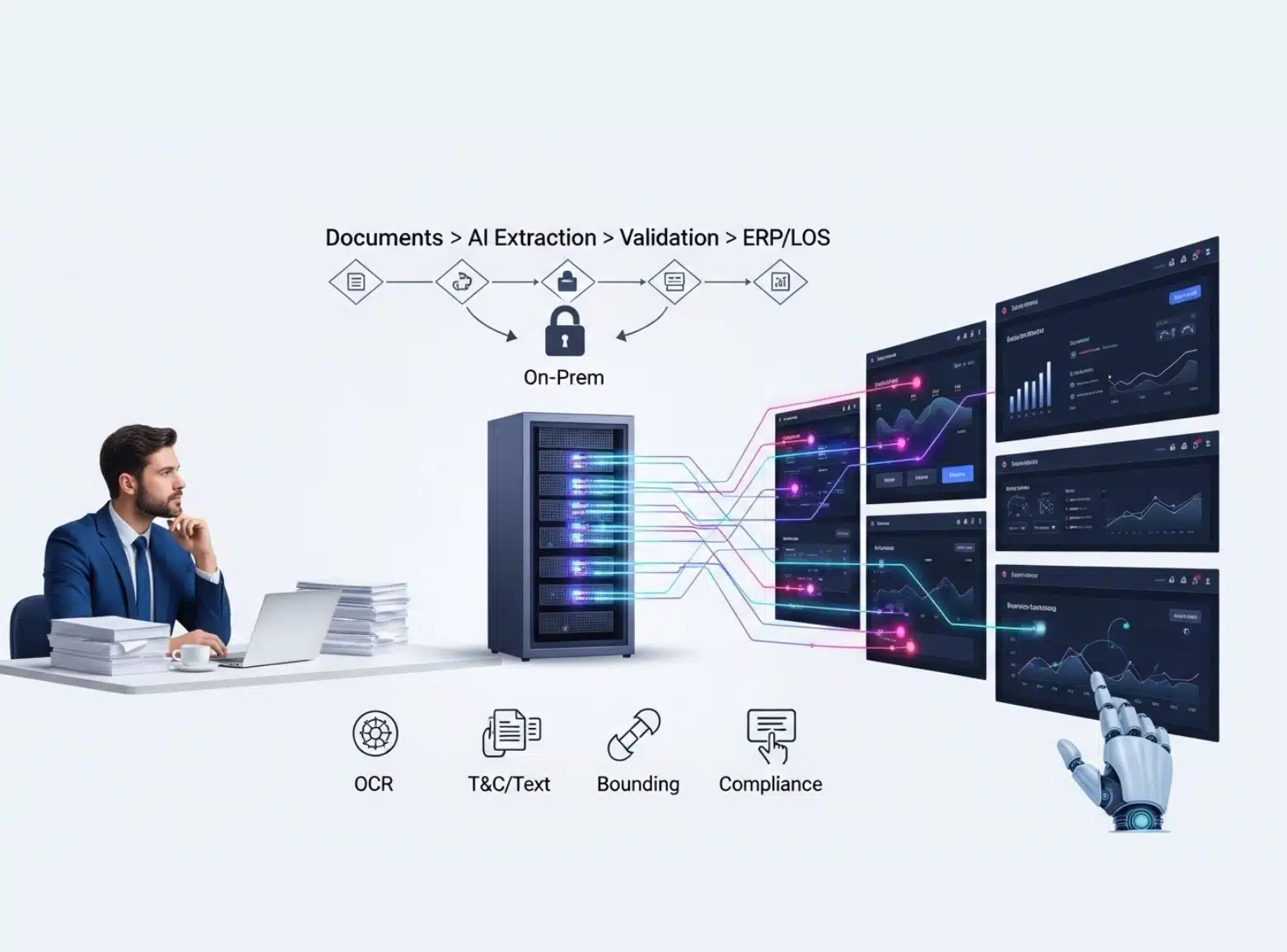
Transforming Finance Operations into Privacy-First, High-Velocity Automation.
A mid-to-large financial institution processing 100–500k invoices annually (or
5–50k loan applications) needed faster, more accurate document handling— while keeping PII on-prem and maintaining full auditability. We delivered a privacy-first automation pipeline combining on-prem OCR, selective edge VLM for complex layouts, fine-tuned small LLMs for validation, and RPA orchestration integrated with ERP/LOS systems. The result: reduced manual effort, faster cycle times, improved data quality, and full compliance-ready provenance.
Problem Statement
Current processes rely heavily on manual capture and data entry, creating bottlenecks and errors. Accounts Payable suffers from frequent PO mismatches, inconsistent line-item extraction, and delayed postings, while Loan Origination involves complex multi-page PDFs and significant underwriter review effort. Cross-cutting constraints—such as the requirement to keep PII on-prem and maintain provenance and explainability—further complicate automation adoption. The result is slow cycles, high costs, error-prone entry, and elevated regulatory risk.
Manual Capture
Emails, portals, and scans across diverse templates.
Accounts Payable Issues
PO mismatches, inconsistent extraction, slow approvals, delayed postings affecting cash flow.
Loan Origination Challenges
Multi-page PDFs (IDs, paystubs, bank statements) in varied formats; heavy manual data entry and underwriter effort.
Compliance Constraints
PII must remain on-prem; provenance and defensibility required.
Impact of Status Quo
Impact of Status Quo
Our Solution: RPA Finance
A modular, on-prem pipeline for secure ingestion, robust extraction, validation, and RPA-driven integration with human-in-loop support.

Secure Ingestion & Privacy Layer
On-prem endpoints with consent capture, PII masking/redaction, and encryption using KMS/HSM.
Primary Extraction
PaddleOCR + PP-Structure running locally for structured invoices and standard loan documents.
Selective Edge VLM
Qwen-VL (or equivalent) triggered only for low-confidence OCR or complex layouts.
Small LLM validators
3–7B parameter models, fine-tuned with LoRA/QLoRA on client rules. Perform validation, anomaly detection, and triage with natural-language rationales.
RPA orchestration & integrations
UiPath / Robocorp / Automation Anywhere, API-first with ERP/LOS (UI fallback if required).
Human-in-loop UI
React/Typescript dashboard with page previews, OCR overlays, extracted fields, LLM rationales, and quick edit options. All corrections logged for retraining.
Technology Stack
- Infrastructure & Security: Kubernetes (on-prem/private VPC), Vault/KMS/HSM, AES-256 at rest, TLS 1.3.
- Extraction: PaddleOCR + PP-Structure.
- Multimodal Understanding: Qwen-VL (on-prem, quantized runtimes, bbox provenance).
- Validation/Business Logic: Fine-tuned 3–7B LLMs; RAG with Milvus/FAISS.
- RPA Orchestration: UiPath/Robocorp with ERP/LOS integration.
- Datastores & Logging: PostgreSQL, S3-compatible object store, ElasticSearch + Kibana.
- MLOps: Prometheus + Grafana, Great Expectations, model dashboards.
- Human UI: React/Typescript dashboard with OCR overlays and rationales.

Industry Applications
Accounts Payable Automation
Streamlines invoice ingestion, OCR-based extraction, and RPA-driven ERP posting for faster approvals and reduced manual effort.
Loan & Mortgage Origination
Automates processing of multi-page PDFs (IDs, paystubs, bank statements), income summarization, and pre-underwrite scoring to accelerate decision-making.
Regulatory Compliance
Implements a privacy-first architecture ensuring PII remains on-prem with full provenance, explainability, and defensibility for audits.
Financial Data Validation
Uses small LLM validators for anomaly detection, rule-based checks, and natural-language rationales for business logic.
Hybrid Document Processing
Combines OCR for structured documents and selective Vision-Language Models for complex layouts, balancing cost and accuracy.
Continuous Improvement
Captures human-in-loop corrections for retraining, enabling adaptive automation and higher touchless rates over time.
Core Strengths of Our Team
Privacy-First Design
All Personally Identifiable Information (PII) remains on-prem with enterprise-grade encryption.
Hybrid Extraction Approach
PaddleOCR for high-volume cost savings and Vision-Language Models (VLM) for accuracy on complex layouts.
Explainable Validators
Small LLMs provide business-rule rationales along with confidence scores for transparency.
Seamless Integration
RPA-first orchestration with ERP/Loan Origination Systems and human-in-loop flexibility.
Continuous Improvement
Feedback loop captures human corrections for retraining, increasing touchless automation rates over time.
Business Impact & Benefits
- Touchless Rates: Achieved 50–85% automation in Accounts Payable pilots (vendor/template dependent).
- Loan Pre-Underwrite Time: Reduced by 40–60%, accelerating decision-making and improving customer experience.
- Data Quality: Improved accuracy with fewer downstream exceptions and errors.
- Compliance: PII remains on-prem; full provenance and natural-language rationales ensure auditability.
- Cost Efficiency: OCR handles bulk volume while Vision-Language Models are used only for complex cases, optimizing cost and performance.
Conclusion
The case study demonstrates how a privacy-first, on-prem automation pipeline can transform finance operations by addressing critical challenges in Accounts Payable and Loan Origination. By combining OCR for high-volume processing, selective Vision-Language Models for complex layouts, and small LLM validators for compliance-ready validation, the solution delivers speed, accuracy, and security. Integrated RPA orchestration and human-in-loop capabilities ensure seamless workflows while maintaining full auditability. This approach not only reduces manual effort and operational costs but also improves data quality and compliance, enabling financial institutions to achieve high-velocity automation without compromising privacy.