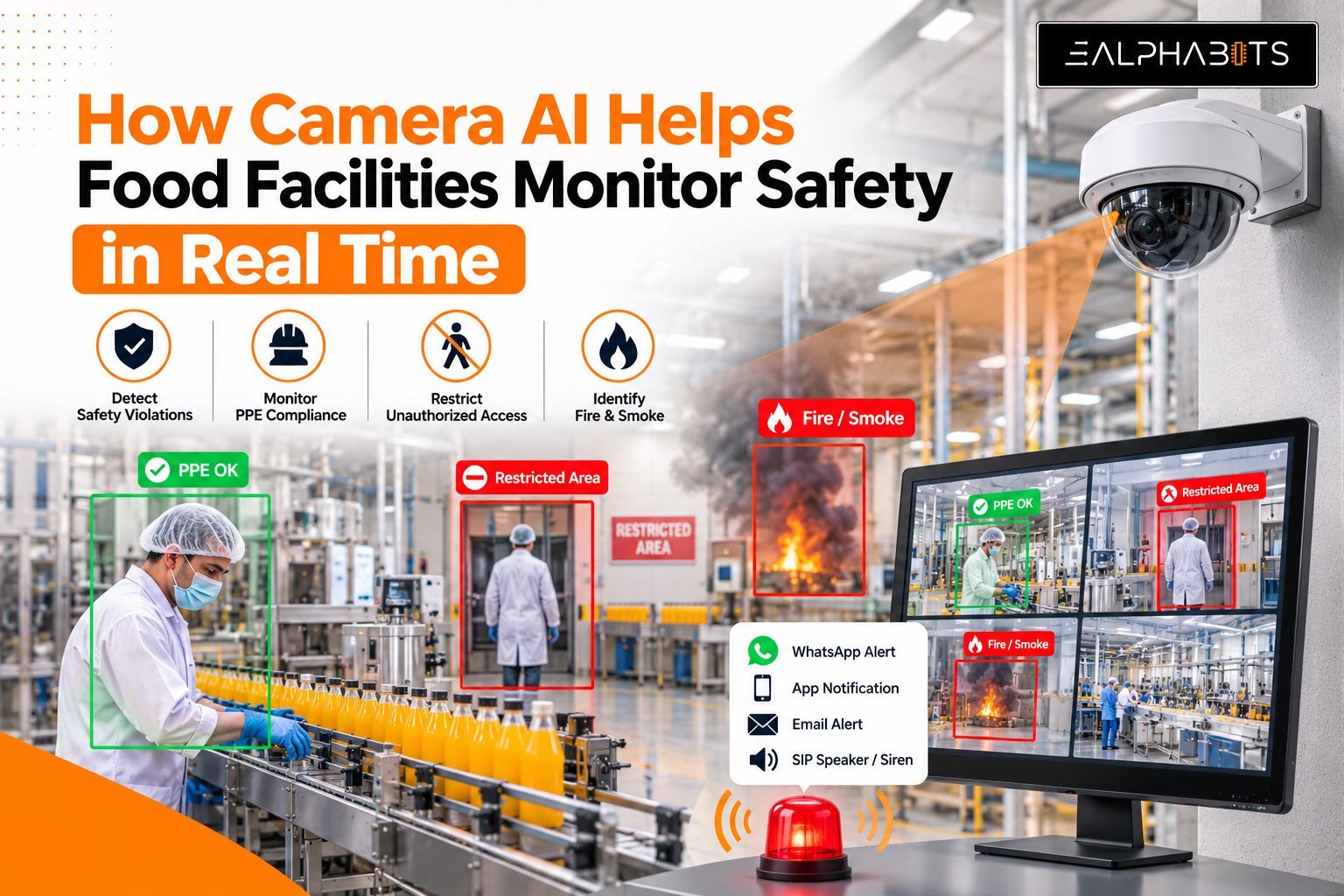
Food and beverage manufacturing depends on consistency at every stage.
From the production floor to packaging and storage areas, teams must maintain defined safety, hygiene and operational practices. However, large facilities can involve multiple production lines, shifts, restricted zones and employees working across different areas.
This creates a simple challenge: how can teams maintain better visibility without relying on someone to watch every camera, every minute of the day?
This is where AI video analytics for the food and beverage industry can add another layer of operational visibility.
Camera AI does not replace food safety procedures, quality teams or regulatory requirements. Instead, it can help facilities use their existing camera infrastructure to automatically detect selected visual events and send real-time alerts when those events require attention.
Why Visibility Is a Challenge in Food Manufacturing
A large food manufacturing facility can have cameras across production areas, entrances, storage zones and other operational spaces.
Traditional CCTV records what happens. But recording an event and identifying it in real time are two very different things.
A safety or compliance issue may be captured on camera, but someone may need to:
- Watch multiple live feeds
- Notice the event
- Verify what happened
- Inform the responsible team
- Take the required action
This process depends heavily on continuous human monitoring.
For a large facility operating across multiple shifts, watching every feed consistently is difficult.
Camera AI for food safety can help shift the approach from continuous video watching to event-based monitoring.
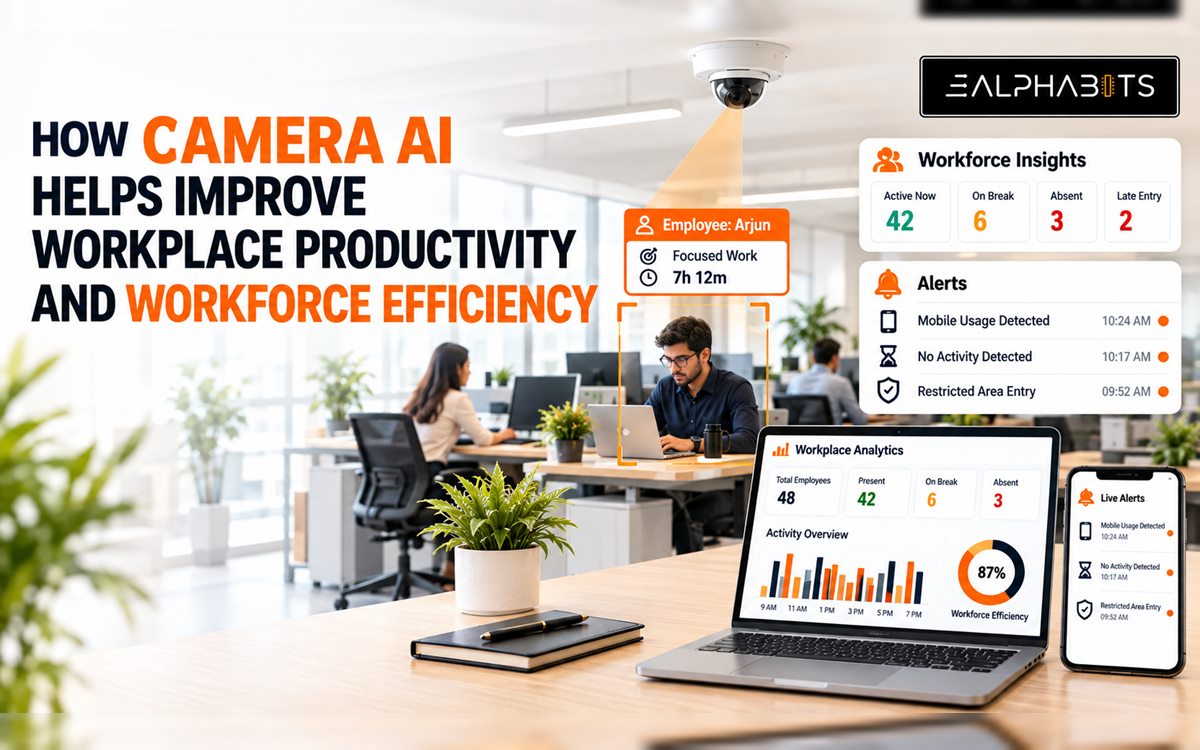
Instead of asking a person to constantly look for a problem, AI-powered video analytics can analyse configured camera feeds and flag specific visual events.
How Camera AI Adds Real-Time Visibility
The process is straightforward:
Existing CCTV → Camera AI → Event Detection → Real-Time Alert → Action
Compatible cameras already installed across a facility can provide the visual input.
Camera AI then analyses the video feed for specific events that have been configured for the environment.
When an event is detected, the system can generate an alert through channels such as:
- App notifications
- SMS
- Dashboards
- SIP speakers or sirens
- Integrated third-party systems
E-Alphabits’ Camera AI is designed to work with compatible existing camera infrastructure, allowing businesses to add an intelligence layer without necessarily replacing their current cameras. The system can be deployed with edge processing to support real-time analysis while keeping video processing close to the facility.
Monitoring PPE and Defined Safety Practices
Personal protective equipment can be an important part of workplace safety in food manufacturing environments.
Depending on the facility and the task being performed, teams may be required to use specific protective equipment.
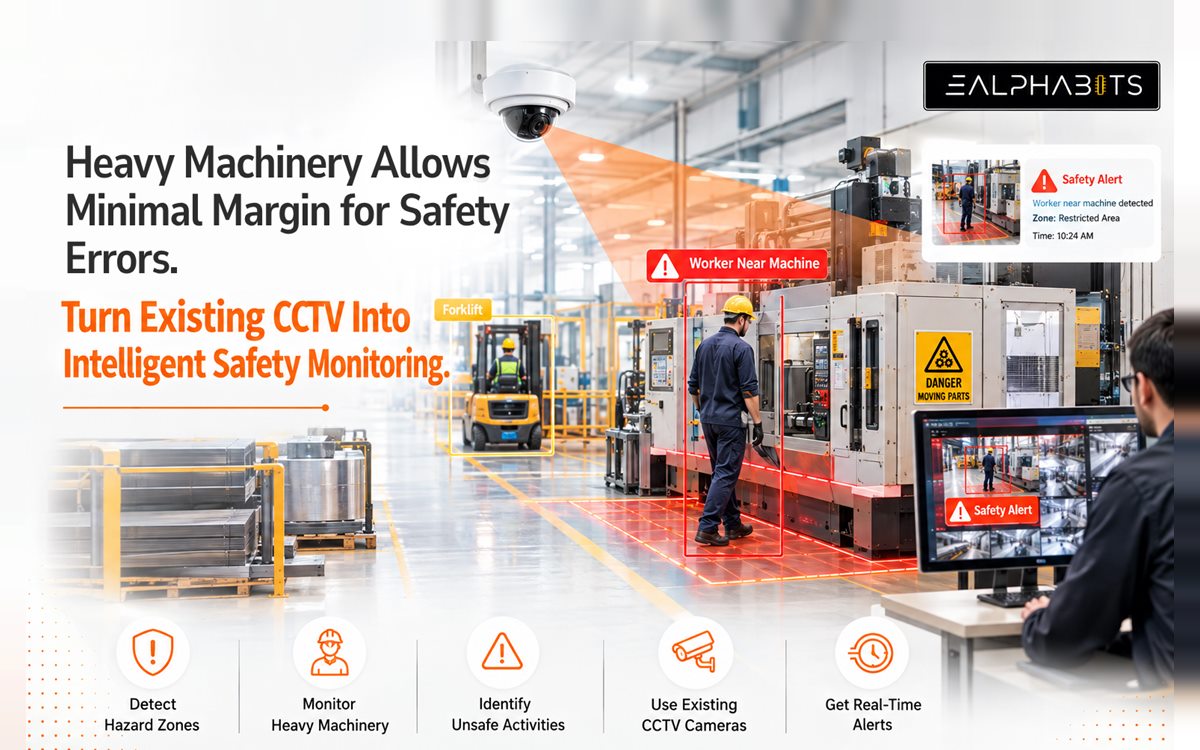
Camera AI can be configured to detect defined visual PPE requirements, helping safety teams identify events that require attention.
For example, a configured system may monitor for:
- Safety helmets in designated industrial areas
- Gloves where visually detectable
- Masks
- Other defined protective equipment
The purpose is not to replace supervisors or compliance procedures.
Instead, food manufacturing safety monitoring can be strengthened by creating another layer of automated visual awareness.
When a configured violation is detected, the responsible team can receive a real-time alert and review the event.
Monitoring Restricted and Controlled Areas
Food and beverage facilities often include areas where access needs to be controlled.
These may include:
- Production zones
- Storage areas
- Equipment rooms
- Utility areas
- Other restricted operational spaces
Traditional access control can record who enters through a designated point. However, visual monitoring can provide additional information about movement within a defined area.
Camera AI can detect a person entering a configured zone and generate an alert when the event matches the monitoring rules.
This can support teams in monitoring:
- Unauthorised entry
- Movement into restricted areas
- After-hours presence
- Defined zone breaches
Using existing CCTV AI integration, facilities can add this capability to compatible cameras already positioned around operational areas.
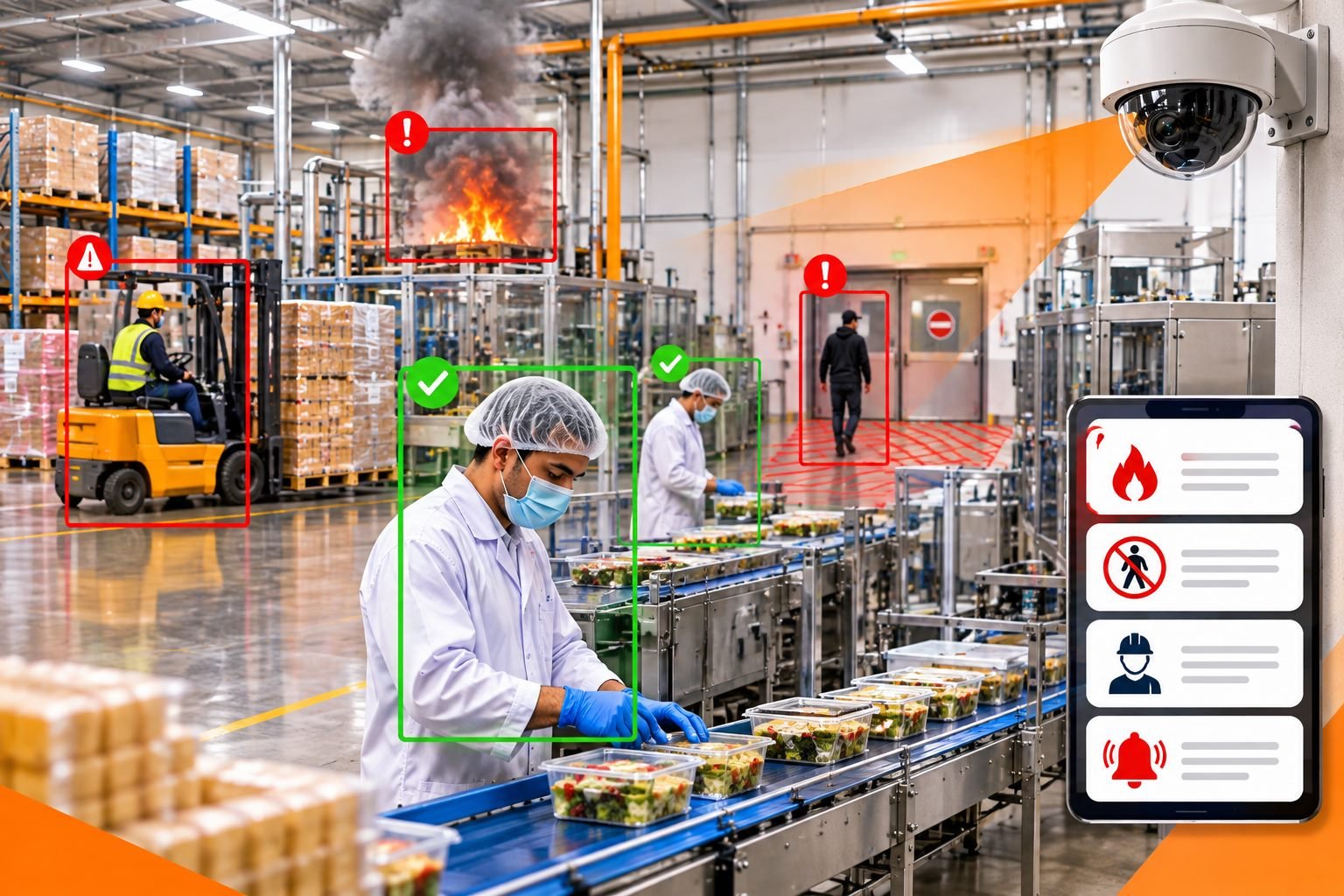
Fire and Smoke Detection for Faster Awareness
Fire and smoke can become critical events in any industrial environment.
Visual fire and smoke detection can provide an additional monitoring layer by analysing camera feeds for visible signs of these events.
When a configured event is detected, Camera AI can trigger real-time safety alerts to inform responsible personnel.
A response workflow may look like this:
Camera detects visible event → AI analyses the feed → Alert is generated → Responsible team is notified → Event is reviewed and action begins
Local alerts can also be connected to systems such as speakers or sirens where appropriate.
Camera AI should be considered an additional visual monitoring layer and not a replacement for certified fire detection and safety systems.
Moving From Recorded Footage to Event-Based Monitoring
One of the biggest advantages of AI-powered video analytics is the ability to focus attention on selected events.
Traditional CCTV can generate hours of footage every day.
Reviewing that footage manually takes time and often happens only after an incident has been reported.
With Camera AI, the approach can become more event-focused.
Instead of reviewing an entire day’s footage, teams can focus on detected events such as:
- A person entering a restricted zone
- A defined PPE violation
- Fire or smoke
- Unauthorised access
- Other configured safety events
This does not mean every event should be treated as an emergency. The detection rules and alert workflow should be designed around the facility’s actual requirements.
The goal is to help teams receive relevant visual information sooner.
Real-Time Alerts Can Connect Detection With Action
Detection alone has limited value if the right people are not informed.
That is why alert integration is an important part of industrial safety monitoring AI.
Depending on the deployment, E-Alphabits Camera AI can connect detected events with different alert channels.
For example:
PPE Event
Detection → Screenshot or event information → Responsible team receives alert → Review and action
Restricted Area Entry
Person detected → Zone rule triggered → Security or operations team notified
Fire or Smoke Event
Visible event detected → Immediate notification → Local warning if configured → Response procedure begins
The exact workflow can be designed around the facility and the type of event being monitored.
This helps transform video from a passive record into a source of actionable information.
Why Existing CCTV Can Be the Starting Point
Many manufacturing facilities already have cameras installed.
Replacing an entire camera infrastructure simply to introduce AI may not always be necessary.
E-Alphabits supports compatible IP camera feeds through standard connections such as RTSP and ONVIF, while other existing camera setups may be connected through appropriate DVR or NVR infrastructure.
This makes existing CCTV AI integration a practical starting point for many facilities.
The process can be:
Keep Compatible Cameras → Add Camera AI → Configure Required Detection → Set Alert Rules
This approach can allow a business to start with selected high-priority areas and expand the use cases as operational requirements evolve.
Custom Detection for Different Facilities
Not every safety requirement can be addressed with a standard algorithm.
A food processing facility may have a unique workflow, object, process or event that needs visual monitoring.
This is where custom computer vision can become relevant.
E-Alphabits develops Camera AI and custom AI models for real-world deployment, allowing the detection approach to be assessed according to the specific operational requirement.
For example, a facility may need to monitor a particular:
- Area condition
- Safety practice
- Object
- Production event
- Access rule
- Operational workflow
The first step is determining whether the event can be reliably identified through visual data.
Camera AI Is an Additional Layer, Not a Replacement for Food Safety Systems
It is important to define the role of Camera AI clearly.
Camera AI is not a replacement for:
- Food safety management systems
- Quality assurance teams
- Certified fire detection systems
- Access control systems
- Human safety supervision
Instead, it can add real-time visual awareness to selected events within the facility.
This approach allows technology and human decision-making to work together.
How E-Alphabits Supports Food and Beverage Operations
E-Alphabits develops Camera AI, IoT and AI Automation solutions for real-world business environments.
For food and beverage facilities, Camera AI can be assessed for applications such as:
- PPE monitoring
- Restricted-area detection
- Unauthorised person detection
- Fire and smoke detection
- Defined safety event monitoring
- Real-time alerts
- Custom computer vision requirements
The solution can work with compatible existing CCTV infrastructure and can be designed around the specific monitoring requirements of the facility. E-Alphabits also supports alert and analytics integrations, allowing detected events to be connected with operational workflows.
The focus is not simply on adding AI to cameras.
It is about identifying which visual events matter to the facility and building a practical detection and response workflow around them.
Planning Camera AI for an industrial site?
See Camera AI for Heavy Machinery Safety for hazard-zone alerts, Camera AI in Manufacturing for production-floor use cases, and Adding AI to Existing CCTV for how the integration works.
Conclusion
Food safety and operational safety depend on more than recorded video.
Large food and beverage facilities need timely visibility into the events that matter.
AI video analytics for the food and beverage industry can help turn compatible existing CCTV into an additional layer of real-time visual intelligence.
From defined PPE monitoring and restricted-area detection to visible fire and smoke events, Camera AI can help teams receive relevant information when a configured event occurs.
The goal is not to replace existing food safety systems or human expertise.
It is to make visual information more useful.
With E-Alphabits Camera AI, businesses can assess how existing camera infrastructure, edge AI and real-time alerts can work together to support safer and more visible food and beverage operations.
Frequently Asked Questions
Can Camera AI detect fire and smoke?
Camera AI can be configured for visual fire and smoke detection where the camera view and environment are suitable. It should be used as an additional monitoring layer rather than a replacement for certified fire detection systems.
How are Camera AI alerts delivered?
Depending on the deployment, alerts can be delivered through channels such as WhatsApp, SMS, email, app notifications, dashboards and integrated systems.
Can Camera AI monitor restricted areas?
Yes. Defined zones can be configured for monitoring. When a person enters a monitored area, the system can detect the event and trigger an alert based on the configured rules.
Can E-Alphabits build custom Camera AI detection?
E-Alphabits can assess custom computer vision requirements based on the specific event or object that needs to be detected and whether reliable visual data is available for the use case.