Supply chain and logistics businesses manage a continuous flow of products, documents, data, and communication. From purchasing raw materials to delivering products to customers, every stage depends on accurate information and timely decisions.
Purchase orders, supplier invoices, shipment records, delivery schedules, warehouse reports, transport documents, and customer requests are created every day. In many businesses, employees still manage these tasks through spreadsheets, emails, manual data entry, and multiple disconnected systems.
This can create several operational challenges: Repetitive documentation work, delays in invoice and purchase order processing, difficulty finding shipment information, errors in manual data entry, and delays in preparing reports.
Employees may spend several hours collecting information that already exists inside company systems. This reduces the time available for planning, problem-solving, customer service, and business growth.
Custom LLM Solutions for Supply Chain and Logistics can help businesses use their existing data more intelligently, automate repetitive processes, and create a more connected operational environment.
What Is a Custom LLM Solution?
A Custom Large Language Model, or Custom LLM, is designed around a company’s specific data, terminology, workflows, and business requirements.
Unlike a general public AI tool, a Custom LLM can be configured to work with approved business information such as:
- Supplier records
- Purchase orders
- Invoices
- Shipment documents
- Warehouse policies
- Inventory reports
- Delivery schedules
- Transport records
- Customer details
- Internal operating procedures
- Compliance documents
The system can help employees search for information, summarize documents, generate reports, answer business questions, and support automated workflows.
For example, a logistics manager could ask: “Which shipments are delayed because the required documents are missing?”
The Custom LLM can retrieve information from connected business records and present the relevant details in a simple and organized format.
It works as an intelligent layer between employees, business data, and existing software systems.
Why Public AI Tools May Not Be Enough for Logistics Businesses
Public AI tools can be useful for general writing, brainstorming, and basic information tasks. However, supply chain and logistics operations often involve confidential business information and highly specific workflows.
Uploading such information into public AI tools may create concerns related to data handling, access control, usage costs, and compliance requirements. Businesses may also spend more on token-based usage when employees process large documents or repeatedly use AI tools for routine tasks.
Another challenge is that general AI tools may not understand the company’s internal processes. They may not know the meaning of internal supplier codes, approval rules, ERP fields, or logistics-specific documentation.
A Custom LLM can be developed around the organization’s own requirements. Depending on the deployment model, it can run within the company’s premises or private infrastructure, helping the business maintain greater control over confidential information.
Key Applications of Custom LLM in Logistics
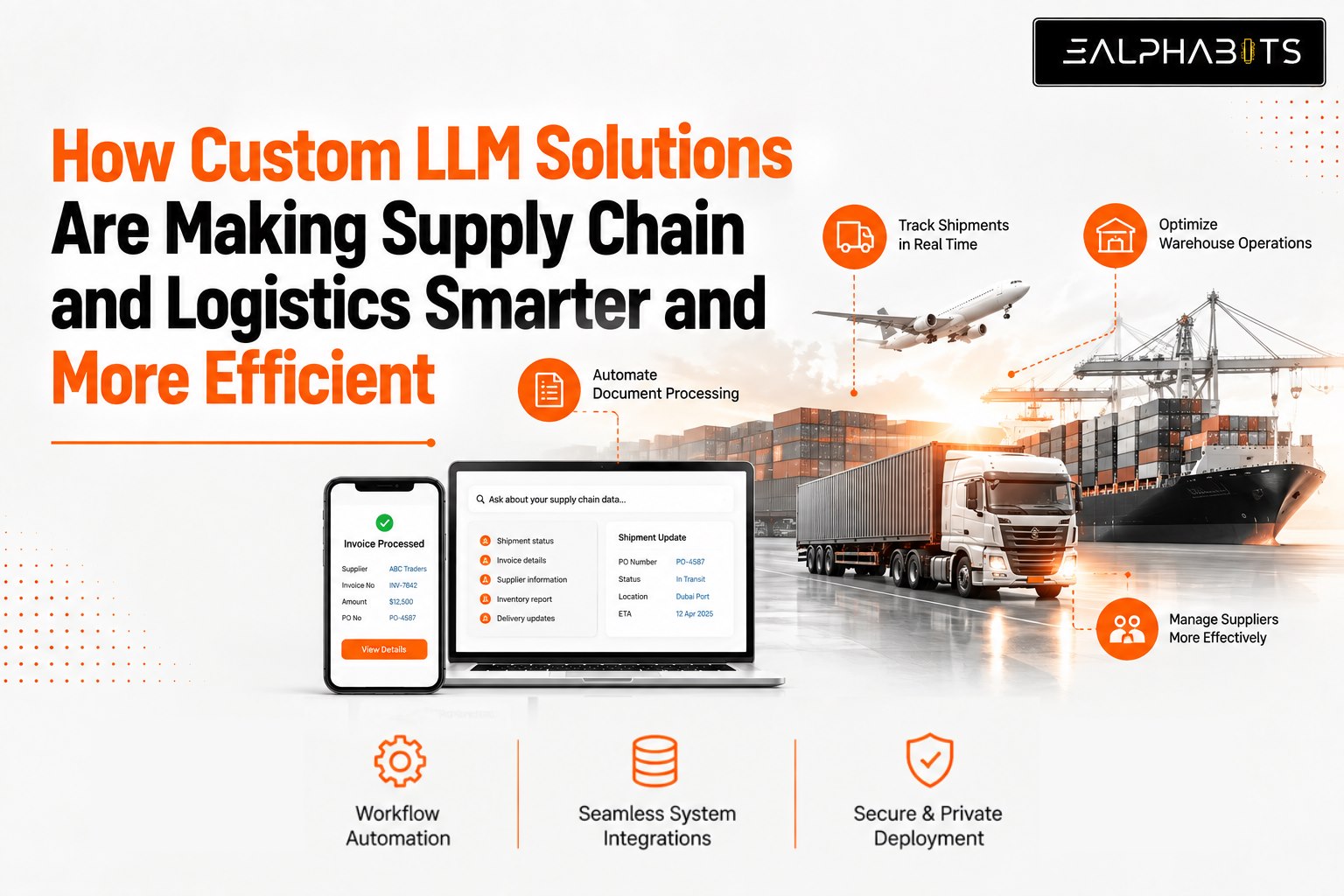
1. Purchase Order and Invoice Processing
Procurement and finance teams process large volumes of purchase orders, invoices, receipts, and delivery documents.
Manual processing requires employees to read documents, find important details, and enter them into business software.
The extracted information can be compared with existing purchase orders. If the invoice amount or quantity does not match the approved order, the system can flag the issue for review.
A typical workflow may look like this:
Invoice received → Information extracted → Purchase order matched → Mismatch identified → Approval routed
E-Alphabits provides document automation using OCR, layout-aware extraction, classification, routing, confidence scoring, human review, audit trails, and ERP or CRM integration.
2. Shipment and Delivery Information Search
Logistics employees often need quick answers about shipment status, expected delivery dates, missing documents, and customer commitments.
Without an intelligent search layer, employees may need to check several systems or contact different departments.
A Custom LLM can allow employees to ask questions such as:
- Which shipments are delayed today?
- What is the status of a specific purchase order?
- Which deliveries are scheduled for dispatch?
- Which customer orders have missing documents?
- Which shipments have crossed their expected delivery date?
- What documents are required for a particular shipment?
The system can retrieve relevant information and provide a summarized response.
This reduces time spent searching through files and helps teams respond to customer and operational requests more quickly.
3. Warehouse Documentation and Reporting
Warehouse teams manage receiving, storage, picking, packing, dispatch, returns, and inventory checks.
A Custom LLM can support warehouse employees by helping them find procedures and prepare operational summaries.
A warehouse manager could ask: “Prepare a summary of delayed orders and pending dispatches for today.”
The system can collect information from connected records and prepare a report for review.
4. Supplier and Vendor Management
Supplier communication is a major part of supply chain operations. Procurement teams need to track confirmations, delivery commitments, quality documents, pricing details, and pending responses.
A Custom LLM can help employees search supplier information and prepare summaries from approved records.
Pending Confirmation Tracking
Identify which suppliers have not confirmed purchase orders or delivery dates within the expected timeframe.
Missing Compliance Documents
Surface suppliers with incomplete quality certificates, compliance records, or onboarding documentation.
Delivery Delay Summaries
Quickly generate a summary of delayed supplier deliveries and their impact on production or dispatch schedules.
Supplier Information Retrieval
Search and retrieve pricing details, approved vendor lists, contact information, and performance history in seconds.
This gives procurement teams better access to information without requiring them to manually review every email or document.
5. Transport and Fleet Coordination
Transport operations involve delivery schedules, driver information, vehicle records, route documents, maintenance reports, and customer updates.
A Custom LLM can help transport managers organize this information and prepare useful reports.
When connected with workflow automation, the system can also notify the relevant team when a delivery exception or missing document is identified.
E-Alphabits develops AI agents, retrieval-augmented systems, multi-step workflows, and tool integrations that connect AI solutions with business applications and data sources.
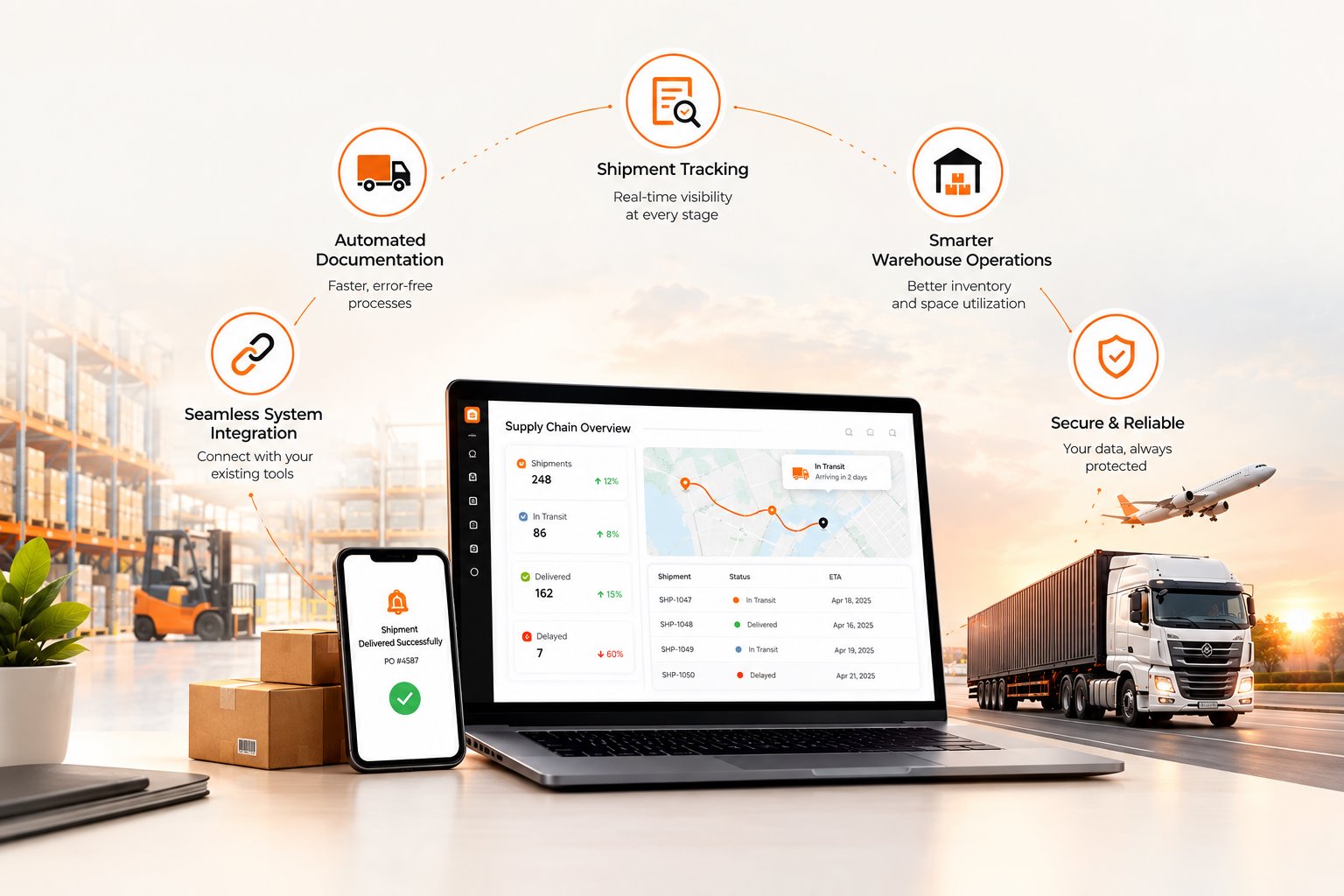
Reducing Repetitive Documentation Work
One of the major benefits of Custom LLM Solutions is reducing the amount of repetitive documentation handled manually by employees.
For example, a business may receive hundreds of supplier invoices every month. Employees may need to open each file, read the information, enter details into an ERP system, verify the purchase order, and send the document for approval.
Human review can remain part of the workflow for financial, compliance, and other sensitive decisions.
The objective is not to remove employees from the process. It is to reduce repetitive work and allow employees to focus on activities that require judgment and coordination.
An intelligent layer, not a replacement
Custom LLM Solutions add an intelligent layer on top of the systems a logistics business already uses — ERP, CRM, WMS, TMS — making existing data more accessible without forcing a wholesale technology change.
Building a Private Custom LLM for Your Business
Every organization has different data, processes, and security requirements. For this reason, a Custom LLM should be designed around the business rather than treated as a generic software subscription.
E-Alphabits builds Custom LLMs based on customer data, workflows, infrastructure, and business goals. Its AI Automation services include Custom LLM development, document automation, AI agents, RAG, workflow automation, private deployment, governance, and system integration.
Depending on the project requirements, a solution may be deployed within the company’s premises or private infrastructure.
This approach can help businesses:
- Maintain greater control over confidential information
- Reduce dependence on public AI tools
- Manage access to internal data
- Customize the system around company workflows
- Reduce repetitive token-based usage
- Connect AI with existing business software
- Expand the solution as requirements grow
A private deployment does not automatically remove every security risk. Strong access controls, encryption, monitoring, secure infrastructure, testing, and governance are still important. However, keeping the solution within a controlled environment can support the organization’s data management and privacy requirements.
Why Choose E-Alphabits?
E-Alphabits develops production-focused AI systems across Custom LLMs, document automation, AI agents, workflow automation, Camera AI, and IoT.
The company focuses on building solutions that work with existing business systems rather than forcing organizations to depend on generic SaaS tools. Its engineering capabilities include custom AI models, document pipelines, data integrations, workflow automation, and private deployment options.
For businesses searching for AI automation companies in Ahmedabad, the key requirement is to work with a team that understands both AI technology and real business processes.
E-Alphabits can help organizations explore AI automation services for businesses by identifying repetitive workflows, understanding data requirements, integrating existing systems, and developing a solution based on business objectives.
The same practical, document-focused approach already supports other sectors with large information volumes — see how it applies to banking and financial services and medical records and insurance claims.
Conclusion
Supply chain and logistics businesses manage large volumes of information every day. When employees spend too much time searching documents, entering data, preparing reports, and following up on routine tasks, operational efficiency can suffer.
Custom LLM Solutions can help businesses turn their existing information into a more accessible and useful resource.
From invoice processing and shipment searches to warehouse reporting, supplier coordination, and transport management, Custom LLMs can support employees across several stages of the supply chain.
When combined with document automation, AI agents, and workflow integrations, these solutions can reduce repetitive work, improve information access, and support faster business decisions.
The future of logistics is not only about moving goods faster. It is also about managing information more intelligently.
Build a Custom LLM Solution for your business with E-Alphabits. Designed around your requirements. Built for your premises. Connected to your workflows.
FAQs
1. Can a Custom LLM work with our existing ERP and logistics software?
Yes. A Custom LLM can be connected with ERP, CRM, warehouse management, transport management, databases, and document systems through APIs, connectors, or workflow integrations.
2. How should a business start with Custom LLM development?
Start by identifying one repetitive process with clear business value. Review the available data, existing software, security requirements, and expected outcome before expanding the solution to other departments.
3. Is a Custom LLM useful only for large logistics companies?
No. Small and medium-sized businesses can also use Custom LLM Solutions for focused workflows such as invoice processing, shipment tracking, supplier communication, and document management.
4. Can a Custom LLM reduce documentation workload?
It can reduce repetitive activities such as document reading, information extraction, report preparation, data searching, and workflow routing. The actual improvement depends on the process and implementation.
5. Will employees still have control over important decisions?
Yes. Human review can be included for sensitive decisions, document mismatches, financial approvals, and compliance-related activities.