Robotics is moving beyond controlled industrial environments into warehouses, farms, manufacturing facilities, security operations and other real-world spaces.
As robots become more capable of operating around people and changing environments, the ability to understand what is happening around them becomes increasingly important.
This is where Camera AI and computer vision can add another layer of intelligence.
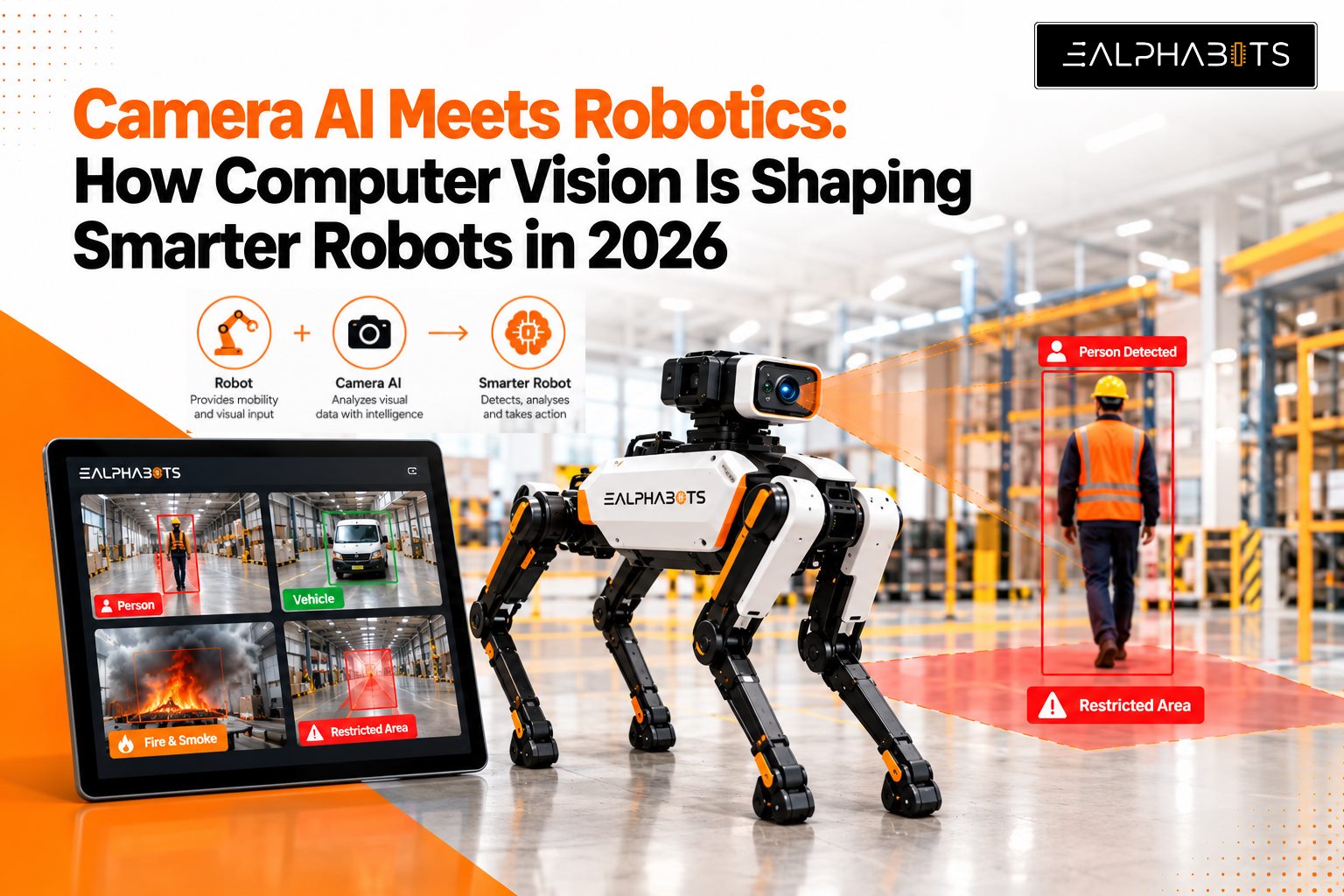
A robot can capture its surroundings through its camera system, while Camera AI can analyse that visual information to detect people, objects, activities, behaviours and safety events.
The result is a system that can do more than move through an environment. It can see, detect, analyse and communicate when a defined event occurs.
How Camera AI Works With Robotics
A robot provides the physical platform and visual input. Camera AI adds the intelligence required to understand what is happening within that visual information. If you are new to that analysis layer, How Camera with AI Works walks through it step by step.
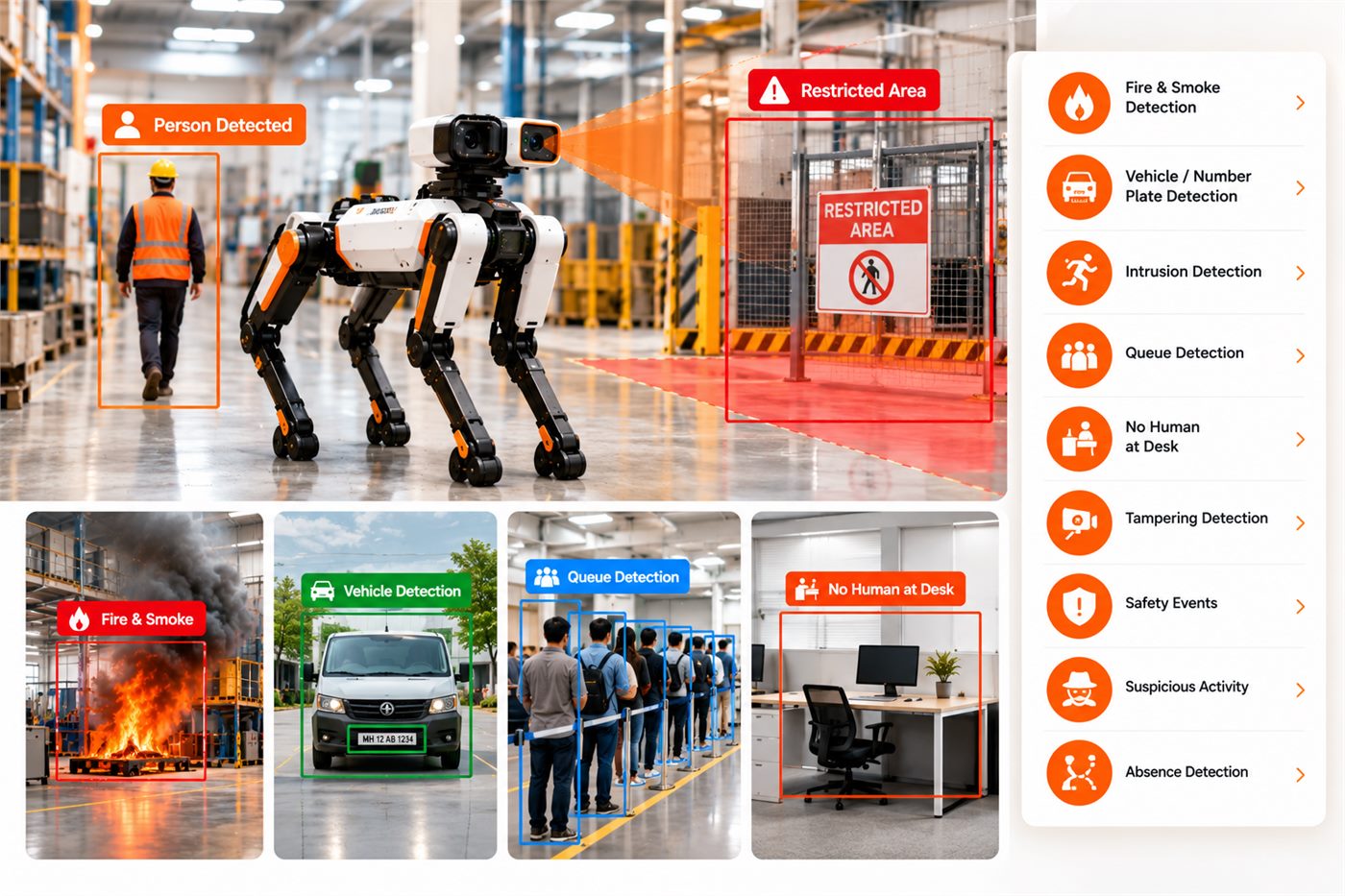
For example, a robot moving through an industrial facility can encounter a person entering a restricted zone.
Camera AI can:
- Detect the person
- Analyse the event
- Check the configured zone or rule
- Trigger an alert
- Communicate the warning locally
- Send a notification to the responsible team
This creates a connection between what the robot sees and what happens next.
What Can Camera AI Help a Robot Detect?
1. Facial Recognition
Camera AI can identify registered individuals through facial recognition.
This can support:
- Authorised person identification
- Controlled access environments
- Workforce identification
- Security monitoring
2. Unauthorised Person Detection
A robot operating within a controlled environment can detect people who are not authorised to be present.
This can be useful in:
- Factories
- Warehouses
- Restricted facilities
- Private premises
- Agricultural locations
3. Restricted Area Detection
Specific zones can be defined for monitoring.
When a person enters a restricted area, Camera AI can detect the event and trigger the required response.
This can be particularly useful when a robot is moving through areas where fixed monitoring does not provide complete coverage.
4. Behaviour Analysis
Camera AI can also analyse defined human activities and behaviours to identify events that require attention.
Possible applications include:
- Activity monitoring
- Movement analysis
- Defined behaviour detection
- Unusual activity monitoring
- Human-robot interaction
5. Gesture Analysis
Human gestures can become another form of communication between people and intelligent machines.
Camera AI can analyse defined gestures and visual movements for applications where a robot needs to recognise specific human signals.
6. Facial Expression Recognition
Computer vision can analyse facial expressions and identify defined visual patterns.
This can support future human-machine interaction applications where visual cues form part of the overall system.
7. Fire and Smoke Detection
A robot moving through a facility can provide visual coverage while Camera AI analyses the video for defined fire or smoke events.
When an event is detected:
- Camera AI identifies the event
- The robot can issue a local warning
- A siren can alert nearby people
- A SIP speaker can communicate a warning
- Remote teams can receive notifications
8. Theft and Security Monitoring
Camera AI can help detect defined events such as:
- Unauthorised person presence
- Restricted-area entry
- Suspicious movement
- Activity around protected areas
- Asset-related events
- Defined theft-related behaviour
When a configured event occurs, the robot can communicate the warning locally while the responsible team receives a remote notification.
Real-Time Safety Alerts From the Robot
Detection becomes more useful when it is connected to an immediate response.
A robot can be equipped with:
- SIP speaker
Voice-based communication so a warning can be spoken to people nearby. - Siren
An audible warning for anyone in the immediate area of the detected event. - App notifications
Alerts delivered to remote teams through the mobile application. - WhatsApp alerts
Quick communication to the people responsible for that area. - SMS alerts
A direct notification channel that does not depend on an app being open.
For example:
Restricted Area Entry
Person detected → Camera AI analyses event → SIP speaker issues warning → Siren activates if required → Remote team receives notification
Camera AI for Agriculture and Farming
The application of Camera AI with robots extends beyond factories and warehouses. Agriculture is another area where computer vision and robotics can work together.
A robot operating across a farm or agricultural environment can capture visual information while Camera AI analyses the surroundings.
1. Crop detection
Camera AI can identify crops and specific visual patterns within agricultural environments.
2. Animal detection
Animals entering defined farming areas can be detected and reported.
3. Human detection
People entering monitored agricultural zones can be identified and alerts can be generated according to configured rules.
4. Field monitoring
The robot can capture visual information across different areas while Camera AI analyses the environment for specific conditions.
The combination of robotics and Camera AI can therefore extend intelligent monitoring across larger and more dynamic agricultural environments.
Why Camera AI Matters for Robotics in 2026
Robotics is increasingly being developed around systems that can perceive and respond to real-world environments.
Computer vision plays an important role because robots need visual information to understand their surroundings and interact with dynamic environments.
In 2026, developments across robotics and computer vision continue to explore areas such as:
- Visual perception
- Object recognition
- Human-robot interaction
- Navigation
- Environmental understanding
- Agricultural monitoring
- Real-world decision-making
For businesses, the opportunity is not necessarily about replacing existing systems with robots.
It can be about adding intelligent visual detection to robotic platforms while continuing to use existing infrastructure.
Existing cameras stay in the picture
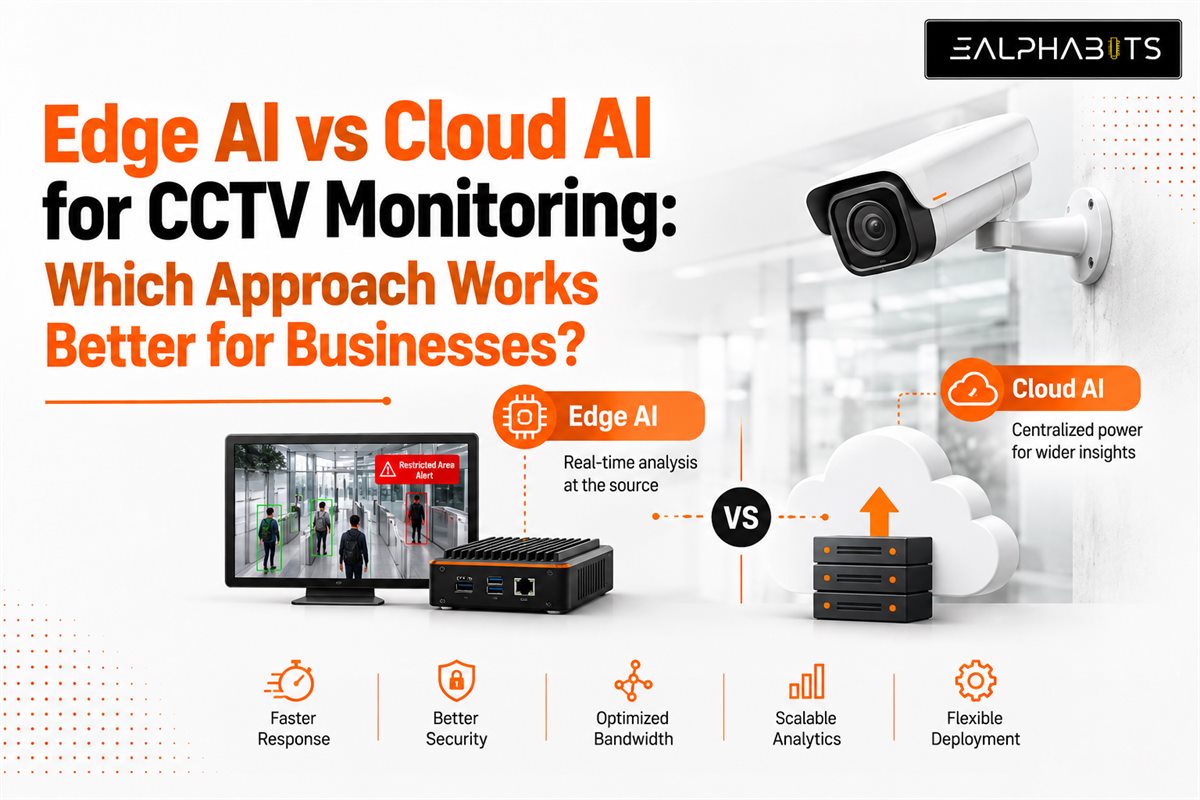
The same detection layer that runs on a robot can run on compatible cameras already installed on site — fixed cameras cover the areas that never change, robots cover the ones that do. See Adding AI to Existing CCTV for how that layer is added, and Edge AI vs Cloud AI for where the processing can sit.
Camera AI by E-Alphabits
Robots can capture their surroundings, but Camera AI can help them understand what they see. E-Alphabits develops Camera AI solutions that bring computer vision, video analytics and real-time alerts into real-world operations.
The same Camera AI capabilities used with existing CCTV infrastructure can also be explored for integration with robots, depending on the robot, camera, connectivity and deployment requirements.
Possible applications include:
- Facial recognition
- Person detection
- Unauthorised person detection
- Restricted-area monitoring
- Behaviour analysis
- Gesture analysis
- Facial expression recognition
- Animal detection
- Fire and smoke detection
- Crop detection
- Custom computer vision requirements
Alert Options
Depending on the application, detected events can trigger:
- SIP speaker communication
- Siren alerts attached to the robot
- WhatsApp notifications
- App notifications
- SMS alerts
For sites that want this packaged as a ready deployment rather than a project, Workplace AI brings safety, security and productivity monitoring together across a facility, and Camera AI for manufacturing covers the same detections on a production floor.
Camera AI is moving beyond fixed cameras. In 2026, it can become an intelligent vision layer across CCTV, robots and other camera-enabled systems.
Frequently Asked Questions
Can Camera AI be integrated with a robot?
Yes. Camera AI can be integrated with a robot’s visual system. The exact integration depends on the robot hardware, camera, processing environment and connectivity.
Can the robot give an audible warning?
Yes. A SIP speaker or siren can be attached to the robot so detected events can trigger a local warning for people nearby.
Can remote teams receive alerts?
Yes. Depending on the deployment, detected events can generate WhatsApp alerts, app notifications or SMS, in addition to local alerts.
Can existing CCTV and robots work with the same Camera AI system?
Depending on the system architecture, Camera AI can be designed to work with different video sources. Existing CCTV can provide fixed-area monitoring while robots can provide mobile coverage.