In manufacturing, a small safety mistake can have serious consequences. A worker entering a restricted machinery zone, a person standing too close to moving equipment, or an unsafe activity going unnoticed can quickly become a workplace hazard. When heavy machinery operates continuously, identifying these risks at the right time is essential.
Most manufacturing facilities already have CCTV cameras installed across production floors, warehouses, loading areas, and equipment zones. These cameras record activity and help teams review incidents. However, traditional CCTV generally depends on someone watching the footage or checking recordings after an event has occurred.
Camera AI changes this approach by helping existing CCTV systems detect defined safety-related events and send alerts when attention is needed.
E-Alphabits brings Camera AI to existing camera infrastructure, helping manufacturing businesses move towards intelligent safety monitoring without automatically requiring a complete camera replacement.
Why Traditional CCTV May Not Be Enough for Manufacturing Safety
Manufacturing environments are busy and constantly changing. Workers move between production lines, forklifts transport materials, machinery operates across multiple shifts, and restricted areas may require continuous attention.
Even with cameras covering important locations, manually monitoring every feed is difficult. Security teams and supervisors may be responsible for several areas at once. A safety issue can develop while their attention is directed elsewhere.
Traditional CCTV also tends to be reactive. If an incident is discovered later, teams can review recordings to understand what happened. But reviewing footage after an incident does not always provide an opportunity to respond before the situation escalates.
A smart surveillance system for manufacturing can help bridge this gap by analysing camera feeds for configured events and notifying the relevant personnel when a potential risk is detected.
The objective is not simply to record more footage. It is to make camera feeds more useful for day-to-day safety operations.
How Camera AI Improves Industrial Safety Monitoring
1. Restricted-Area and Hazard-Zone Monitoring
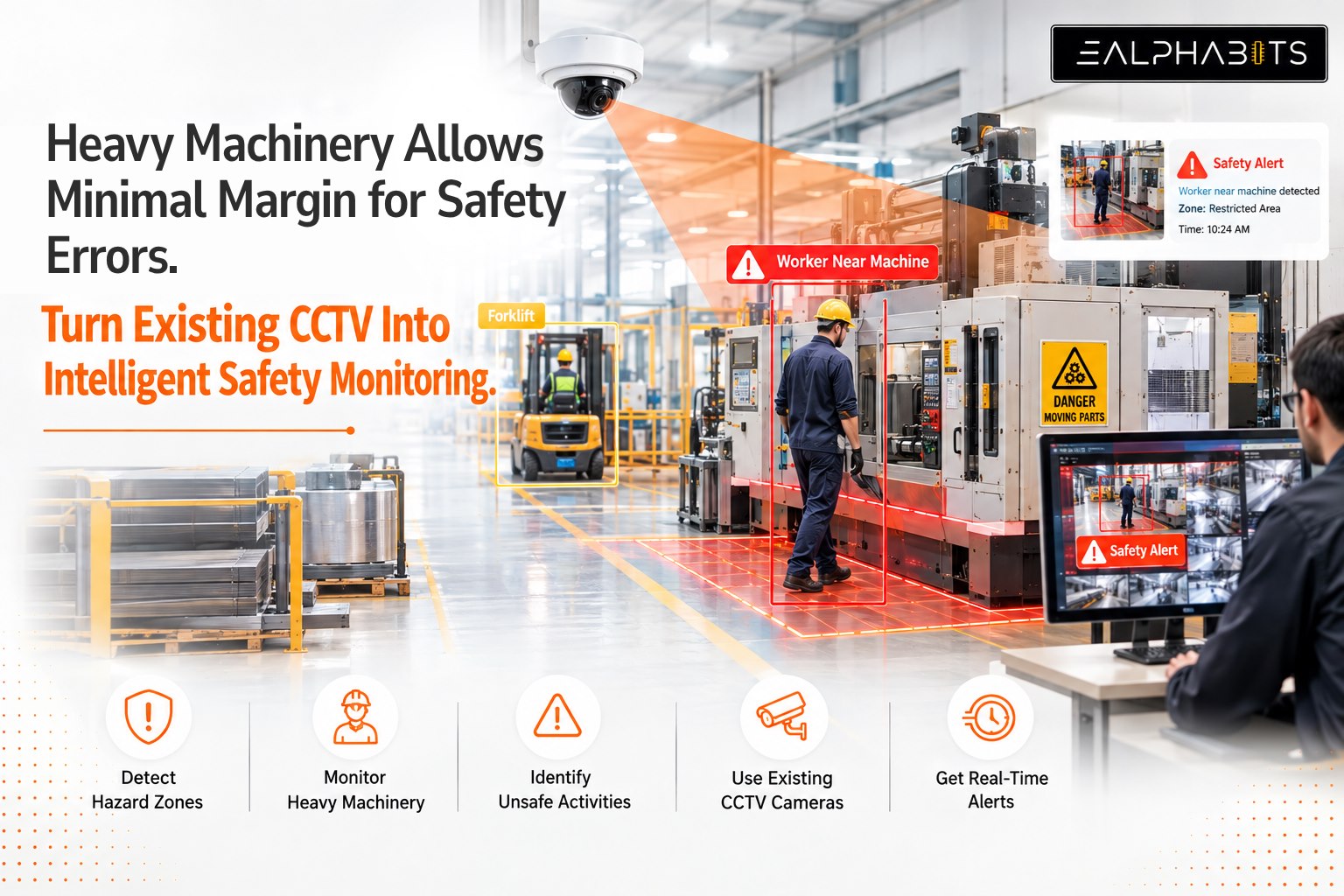
Certain manufacturing areas require controlled access because of moving machinery, hazardous processes, or operational restrictions. When an unauthorised person enters a designated zone, the system can identify the configured event and notify the responsible team.
This helps teams pay attention to locations where access control and safety procedures are especially important.
2. Monitoring Activities Around Heavy Machinery
Heavy machinery requires workers to follow established safety procedures and maintain appropriate distances from hazardous operating zones. Camera AI can be configured for relevant visual safety use cases, such as identifying a person entering a defined danger zone or detecting selected unsafe situations.
The exact capability depends on camera positioning, image quality, lighting, the visual conditions, and the detection model selected for deployment.
By notifying supervisors when configured events occur, Camera AI can help reduce dependence on continuous manual observation. It supports safety teams rather than replacing safety training, physical safeguards, or established operating procedures.
3. Identifying Potential Workplace Safety Risks
Manufacturing safety involves more than machinery. Loading bays, warehouse aisles, production floors, and material-handling areas can all present risks.
With suitable camera views and configured detection models, Camera AI can support monitoring for selected events in these locations. Businesses can prioritise use cases according to their actual operating environment rather than deploying a generic system that does not match their needs.
This makes vision AI solutions useful when the objective is to improve operational visibility across multiple parts of a facility.
Turn Existing CCTV Cameras Into Intelligent Safety Monitoring
One of the practical challenges in upgrading manufacturing surveillance is the cost and disruption associated with replacing installed equipment.
E-Alphabits takes a different approach. Camera AI can be implemented using compatible existing camera feeds, allowing businesses to explore intelligent monitoring without automatically replacing their entire CCTV infrastructure.
Depending on the installation, compatible IP cameras can connect through supported RTSP or ONVIF streams. Many analogue camera systems can also be connected through suitable DVR or NVR infrastructure.
Businesses evaluating the best commercial surveillance cameras should also consider whether their existing camera infrastructure can support AI-based monitoring before investing in new equipment. A compatible AI powered security camera setup can extend surveillance capabilities, depending on the available camera feeds and deployment requirements.
Real-Time Safety Alerts That Help Teams Respond Faster
Detecting a potential safety event is only one part of the process. The information must also reach the right person in a useful and timely manner.
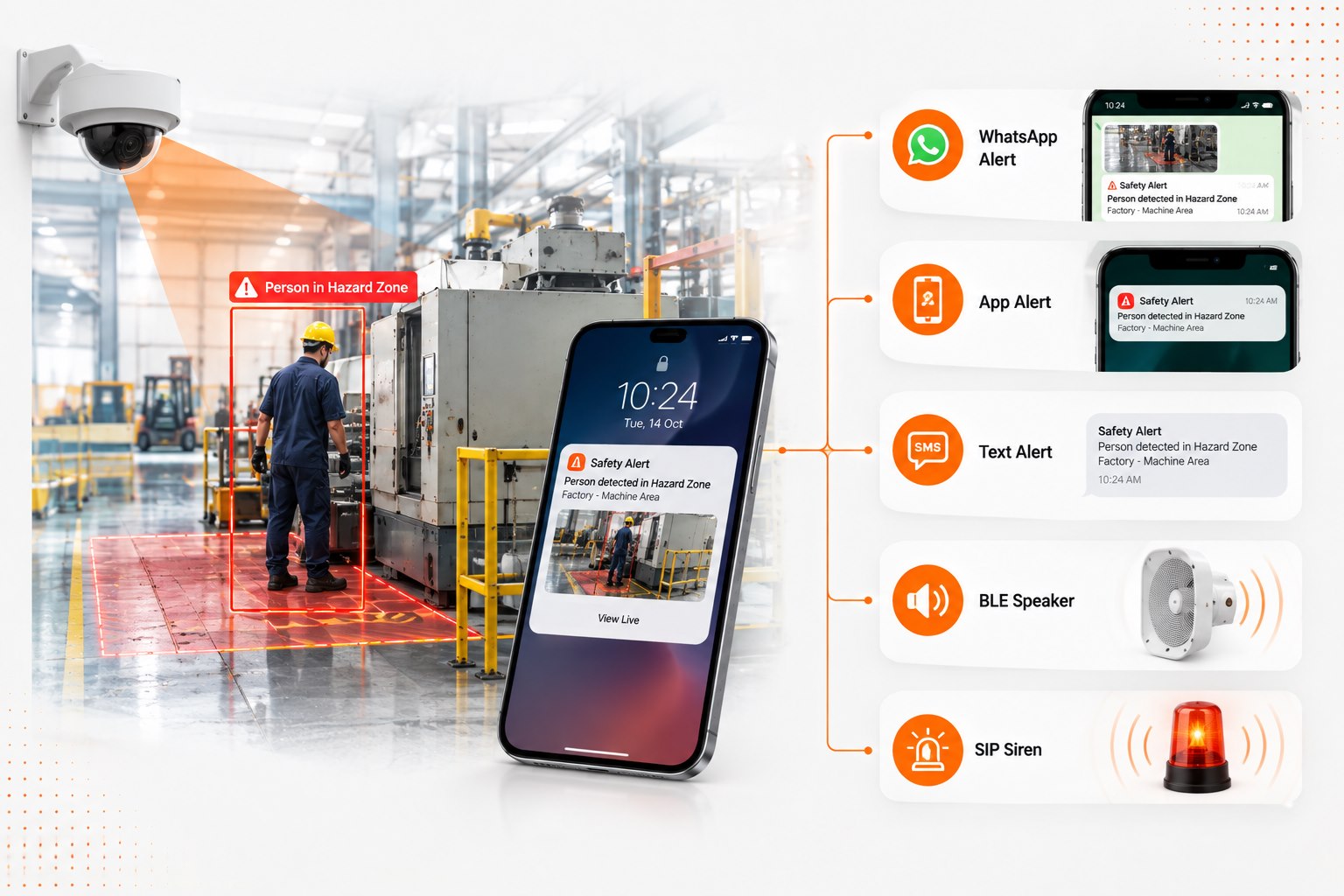
E-Alphabits supports multiple alert options for Camera AI deployments, helping businesses select notification methods suited to their workplace and response procedures. These real-time safety alerts can support manufacturing safety monitoring by helping responsible teams identify events that require attention.
WhatsApp Alerts With a Live Event Screenshot
When a configured event is detected, a WhatsApp alert can include a screenshot from the relevant camera feed, subject to the deployment configuration. This gives the recipient visual context about the event and helps them decide whether further investigation is required.
For example, a supervisor could receive an alert with an image showing a person entering a restricted zone. Instead of relying only on a text notification, the supervisor can review the event context and follow the facility’s response procedure.
Mobile App Alerts
App notifications help authorised personnel receive safety-related alerts on their mobile devices. This is useful for supervisors and safety officers who move between production areas and may not always be near a monitoring desk.
Text Message Alerts
SMS or text notifications provide another way to communicate important events. They can be useful where a concise notification is preferred or where the organisation has defined an SMS-based escalation process.
BLE Speaker Alerts
A compatible BLE speaker can be included in a deployment where local audio notifications are required and supported by the system design. This can help draw attention to a detected event in an appropriate location.
SIP Siren Alerts
A compatible SIP-based siren can be configured for selected events where an audible warning is part of the facility’s response plan. The event rules should be designed carefully to avoid unnecessary alarms and alert fatigue.
The right combination depends on the facility’s network, hardware, alert priorities, and operating procedures. Alerts should support a clear response process, with assigned responsibilities for acknowledging and investigating safety events.
Why Alert Configuration Matters
Not every detected event requires the same response. A person entering a high-risk machinery zone may require immediate attention, while another event may be suitable for review by a supervisor.
A well-planned Camera AI deployment defines which events trigger alerts, who receives them, which channels are used, and what action should follow.
This helps avoid sending every notification to every employee. It also supports a more structured safety workflow in which important events reach the people responsible for handling them.
Camera AI should be tested in the actual manufacturing environment because lighting, obstructions, camera angles, and movement can affect detection performance. Clear alert rules and periodic reviews help teams maintain a useful monitoring system.
An effective industrial CCTV monitoring setup can support a broader workplace safety monitoring system by connecting visual detection with appropriate notifications and established safety procedures.
How E-Alphabits Supports Manufacturing Safety
E-Alphabits develops Camera AI solutions that help businesses use existing camera infrastructure for intelligent video monitoring. Rather than treating CCTV only as a recording system, the approach adds configured detection and alert capabilities to help teams identify events that need attention.
Manufacturing deployments can be planned around specific operational requirements, including restricted-area monitoring and selected workplace safety use cases. Depending on the setup, alerts can be delivered through channels such as WhatsApp, mobile applications, SMS, and compatible audible alert devices.
The system can be designed around supported camera connectivity and an appropriate processing architecture, including edge, cloud, or hybrid deployment where suitable. The choice depends on the facility’s technical requirements, privacy considerations, and operational priorities.
For manufacturing businesses, this means the starting point does not always have to be a complete CCTV replacement. It can begin with an assessment of existing cameras, identifying high-priority risks, and selecting the Camera AI use cases that provide the most practical value.
Planning a Camera AI rollout on the factory floor?
See How Camera AI Helps Manufacturing Industries Improve Safety and Production Efficiency for more plant-floor use cases, Adding AI to Existing CCTV for how existing cameras connect, and Edge AI vs Cloud AI for CCTV Monitoring to choose a processing architecture.
Conclusion: Make Every Camera More Useful for Safety
Heavy machinery leaves little room for overlooked hazards. Manufacturing teams need visibility into important events and a reliable way to communicate when attention is required.
Camera AI helps extend traditional CCTV beyond recording by identifying configured events and delivering alerts through suitable communication channels. By integrating with compatible existing cameras, E-Alphabits helps manufacturing businesses explore intelligent safety monitoring without automatically rebuilding their surveillance infrastructure.
The goal is straightforward: make potential risks easier to identify, help responsible teams respond with better information, and support safer day-to-day operations.
Frequently Asked Questions
Can Camera AI work with existing factory CCTV cameras?
Yes. Camera AI can work with compatible existing camera feeds. Depending on the installation, IP cameras may connect through supported RTSP or ONVIF streams, while many analogue systems can be integrated through suitable DVR or NVR equipment. Compatibility should be assessed before deployment.
What types of safety events can Camera AI monitor?
Possible use cases include restricted-area entry and no-machinery zones, workplace safety events, face recognition, attendance, crowd detection, and fire & smoke detection. The available detections depend on the selected models, camera coverage, image quality, and the conditions at the site.
What alert methods are available?
Depending on the deployment, alerts can be delivered through WhatsApp with an event screenshot, mobile app notifications, SMS or text messages, and compatible BLE speakers or SIP sirens. Device compatibility and alert configuration should be confirmed during implementation.
Can WhatsApp alerts include a screenshot of the detected event?
Yes, a deployment can be configured to send a WhatsApp notification with a relevant event screenshot, where supported. This helps the recipient understand the visual context before deciding on the appropriate response.