Every department creates and uses important information such as client records, employee documents, invoices, reports, forms, contracts, policies, medical records, financial information, and internal communication. Over time, this information becomes difficult to organize and retrieve.
Employees may spend hours searching through folders, checking old records, preparing forms, finding specific codes, reviewing documents, or entering the same information into different systems.
This affects productivity and increases the possibility of manual errors.
Many businesses now use public AI tools to summarize documents or answer questions. However, these tools may not be designed around the company’s internal records, processes, and confidentiality requirements. Repeated usage can also create token-based costs and dependency on external platforms.
A Custom Enterprise LLM Solution provides a different approach.
Instead of relying on a general AI tool, businesses can build their own intelligent system based on their specific requirements, internal documents, business data, and existing infrastructure.
At E-Alphabits, we develop Custom LLM Solutions that can be customized for your business and deployed within your premises or private environment based on your security and operational needs.
What Is a Custom Enterprise LLM Solution?
A Custom Enterprise LLM Solution is a private and business-specific AI system designed to understand and work with an organization’s own information.
It can be built around:
- Client records
- Customer history
- Employee information
- Company documents
- Financial records
- Legal documents
- Medical records
- Product information
- Internal policies
- Forms and templates
- Reports and spreadsheets
- Industry-specific codes
- Previous business transactions
A Custom LLM can act as an intelligent business knowledge system that helps employees find information, understand records, generate documents, prepare forms, and complete repetitive tasks more efficiently.
For example, an employee could ask:
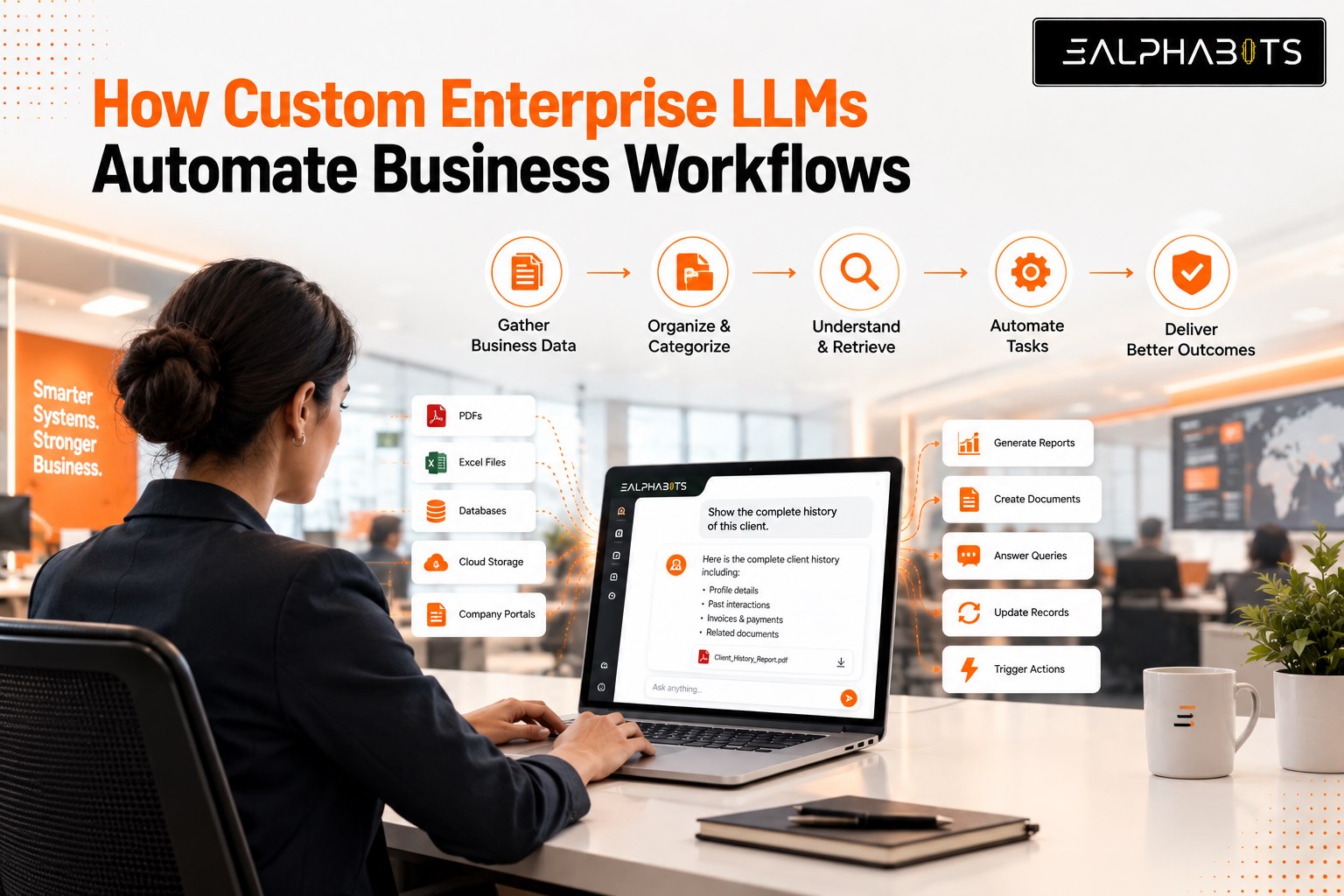
“Show the complete history of this client.”
The system can retrieve relevant information from approved records and present it in an organized format.
This makes business information easier to access without requiring employees to manually search through multiple folders or files.
Why Businesses Need Their Own Custom LLM
Public AI tools are designed for general use. They may be useful for writing, summarizing, or answering common questions, but businesses often need much more specific capabilities.
A company may require an AI system that understands:
- Its internal terminology
- Its document formats
- Its approval process
- Its client history
- Its record structure
- Its industry-specific codes
- Its business rules
- Its reporting requirements
- Its security policies
A general AI tool may not have access to this information or may not be configured to use it in the required way.
Businesses may also face concerns related to confidential information. Client records, contracts, financial documents, and internal reports should not be shared casually with external tools.
With a Custom Enterprise LLM, the system can be designed around the company’s own infrastructure and access rules. This helps businesses maintain greater control over confidential information and reduces dependency on public AI platforms.
A private deployment does not remove the need for security controls. Access permissions, encryption, monitoring, backups, and governance are still important. However, keeping the solution within a controlled environment can reduce unnecessary exposure of sensitive business information.
How a Custom Enterprise LLM Works
1. Collect and Connect Business Information
The first step is to identify the information the system needs to work with.
This may include:
- PDFs
- Excel files
- Scanned records
- Databases
- CRM records
- ERP information
- Internal websites
- Digital forms
- Company policies
The information is organized and connected to the Custom LLM according to the business requirements.
2. Organize Documents and Records
The system can classify documents and arrange them into specific categories or folders.
For example, a business may create separate knowledge areas for:
- Client records
- Finance documents
- HR policies
- Legal contracts
- Product information
- Insurance claims
- Medical references
- Supplier documents
This makes it easier to find the right information when employees need it.
3. Search and Retrieve Relevant Information
Employees can ask questions in normal language instead of using complicated search filters.
Examples include:
- “Find all records related to this client.”
- “Show the last three interactions with this customer.”
- “Find the agreement signed with this supplier.”
- “Show the previous claim history.”
- “Find the correct internal code for this service.”
The system retrieves relevant information from approved sources and provides a response based on the available records.
4. Generate Documents and Forms
A Custom LLM can also help create business documents based on predefined formats.
It may support:
- Application forms
- Client summaries
- Internal reports
- Claim documents
- Follow-up emails
- Case summaries
- Meeting reports
- Compliance documents
For example, an employee may provide basic client information and ask the system to generate a standard application form.
The system can populate the relevant fields and prepare the document for review.
5. Support Human Review
A Custom LLM should support employees rather than remove human responsibility from important decisions.
Employees can review the generated information, correct mistakes, approve documents, and make final decisions where required.
This is especially important for financial, medical, legal, insurance, and compliance-related information.
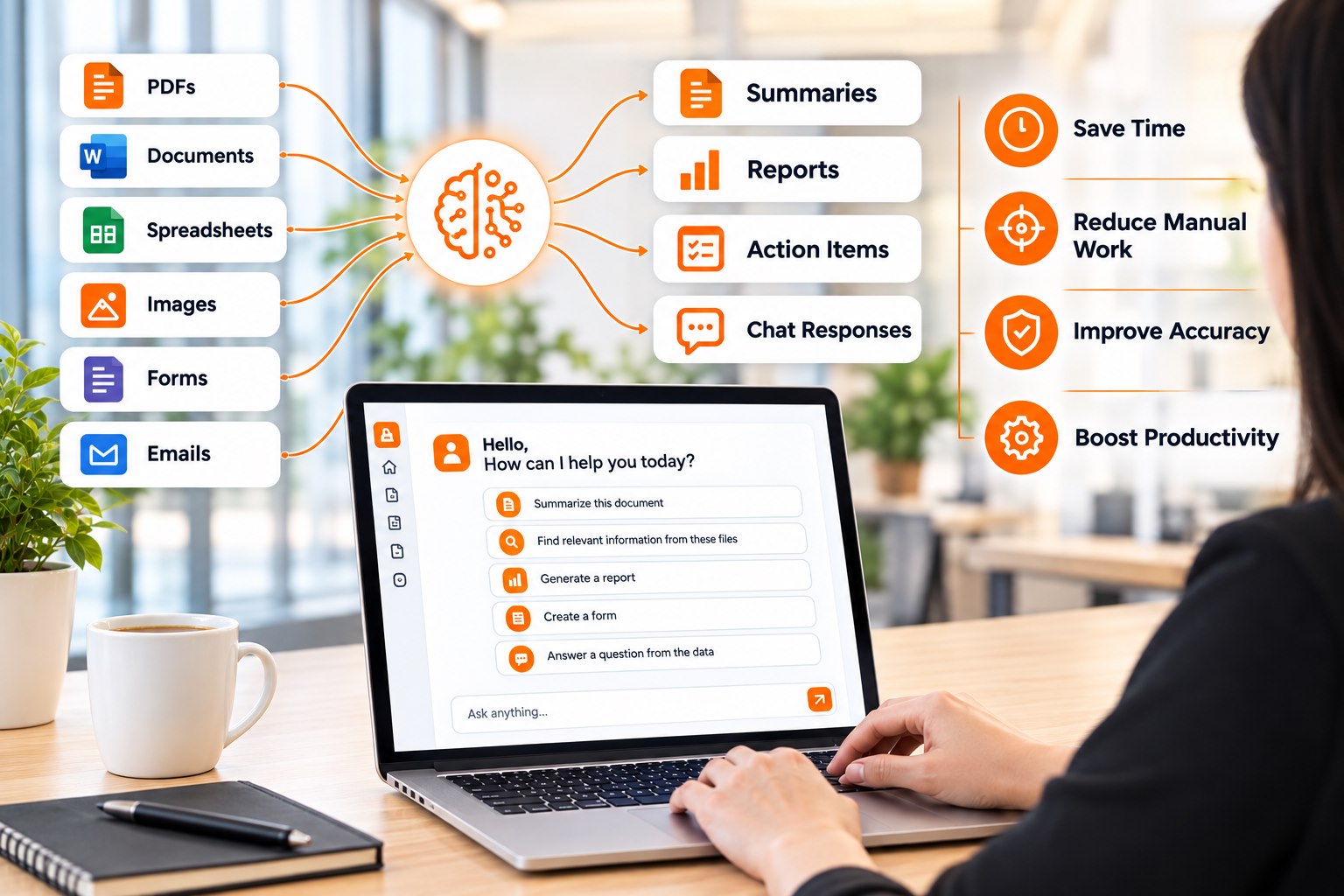
More Than Data Entry: What Businesses Can Automate
Client Records and Customer History
Businesses often maintain long records for each client. These may include previous communication, transactions, service requests, documents, complaints, and follow-up details.
A Custom LLM can help employees retrieve this history quickly.
Instead of opening several files, an employee can ask:
“Summarize this client’s previous requests and pending requirements.”
The system can prepare a structured summary from the available records.
This helps customer service, sales, support, and account management teams save time.
Document Management
Important documents are often stored across different folders and systems. Employees may know that a document exists but still spend time locating it.
A Custom LLM can make internal documents searchable through natural language.
It can help employees find:
- Policies
- Contracts
- Invoices
- Reports
- Product documents
- Internal guidelines
- Previous case records
This creates a more useful internal knowledge library for the organization.
Code and Reference Lookup
Certain industries require employees to search for codes, classifications, or reference information.
For example, healthcare and insurance teams may need to locate disease codes, procedure codes, policy terms, or claim-related information.
A Custom LLM can search approved reference documents and present potentially relevant results.
The final decision should remain with a qualified employee because codes and classifications may require professional judgment and verification.
Chatbot for Internal Business Use
A Custom LLM can also provide a private chatbot for employees.
The chatbot can answer questions related to company information. Employees can ask questions in simple language and receive answers from the organization’s approved knowledge sources.
Unlike a general chatbot, this system is designed around the company’s own information and access permissions.
Form and Report Generation
Preparing forms and reports manually can consume a significant amount of employee time.
A Custom LLM can help generate documents using information from internal records.
For example: Client information → Record search → Required details identified → Form generated → Employee review
It can also help prepare daily summaries, customer reports, case notes, and department updates.
Custom LLM Solutions Built for Your Premises
At E-Alphabits, Custom LLM Solutions are developed around your data, workflows, infrastructure, and business requirements. The company’s AI Automation services include Custom LLM development, document automation, retrieval-based knowledge systems, private deployment, governance, and business system integration.
Your business does not need to adjust its processes to fit a generic AI tool.
Instead, the solution can be customized to match:
- Your document structure
- Your company terminology
- Your employee roles
- Your access permissions
- Your reporting formats
Depending on the project, the solution can be deployed on-premises or within private infrastructure. E-Alphabits highlights on-premises and VPC deployment options for Custom LLM projects.
This approach helps businesses maintain greater control over their information while building an AI system that fits their operational needs.
Why Choose E-Alphabits for Custom LLM Solution?
E-Alphabits builds practical AI systems across Custom LLMs, document automation, AI automation, Camera AI, IoT, and enterprise software.
Its approach focuses on understanding the business problem first and then designing the right technology around it. The company develops systems that can work with existing infrastructure instead of forcing businesses to depend entirely on generic software platforms.
For businesses searching for AI automation companies in Ahmedabad, E-Alphabits can help identify suitable use cases and develop a solution based on the organization’s requirements.
As an Artificial Intelligence solution provider, E-Alphabits focuses on customized implementation, private deployment, document processing, knowledge retrieval, and business workflow improvement.
Businesses looking for AI automation services for businesses can start with one specific challenge and gradually expand the Custom LLM into other departments.
Conclusion
A Custom Enterprise LLM is not limited to data entry.
It can help businesses manage client records, search documents, retrieve history, find reference codes, answer internal questions, generate forms, prepare reports, and organize company knowledge.
Instead of wasting employee time on repetitive documentation or depending completely on public AI tools, businesses can build their own Custom LLM Solution around their data, workflows, and infrastructure.
At E-Alphabits, we build Custom LLM Solutions designed for your specific requirements and deployment environment.
Your data. Your requirements. Your premises. Your Custom LLM Solution.
Build an intelligent business system that helps your employees save time, reduce repetitive work, improve accuracy, and access important information when they need it.
FAQs
How is a Custom LLM different from a public AI tool?
A Custom LLM is built around your company’s data, documents, workflows, and requirements. It can be customized for your business and deployed within your premises or private infrastructure. Public AI tools are designed for general use and may not understand your internal processes.
Can a Custom LLM integrate with CRM or ERP systems?
Yes. A Custom LLM can integrate with existing CRM, ERP, databases, document management systems, and other business applications through APIs or suitable connectors.
What types of business documents can a Custom LLM process?
It can work with documents such as PDFs, Word files, spreadsheets, scanned records, invoices, contracts, reports, forms, emails, policies, and other approved business documents.
How much does a Custom Enterprise LLM cost?
The cost depends on factors such as the number of users, data volume, required features, integrations, security needs, and deployment method. E-Alphabits can help estimate the cost after understanding your business requirements.
Can different employees have different access to information?
Yes. Role-based access can be configured so employees only view the documents, records, and information relevant to their responsibilities. This helps businesses maintain better control over confidential data.