Banks and financial institutions manage some of the most sensitive information in the business world. Customer records, financial statements, loan documents, KYC information, transaction records, compliance documents, and internal policies are generated and updated every day.
The challenge is not simply storing this information. The real challenge is finding the right information quickly and using it efficiently.
Employees may spend hours searching through documents, checking customer records, reviewing policies, or entering the same information into different systems. As the organization grows, these small tasks can become a significant operational burden.
Many financial organizations are now exploring artificial intelligence to reduce this workload. However, using a general AI tool is not always the right approach when sensitive financial information and organization-specific processes are involved.
This is where Custom LLM Solutions can provide a more practical approach. Instead of using a general AI system designed for everyone, a financial institution can have an AI environment designed around its own information, workflows, requirements, and business knowledge.
Why Banks Need More Than Generic AI Tools
Public AI tools can be useful for general tasks such as writing content, summarizing information, or generating ideas. However, financial institutions work with information that is highly specific to their organization and customers.
A generic AI tool does not automatically understand a bank’s internal policies, loan procedures, KYC processes, customer records, or compliance documentation.
Employees may also hesitate to place sensitive business or customer information into public AI platforms because data privacy and access control are important considerations in financial operations.
There is another consideration. Heavy AI usage can involve significant token based costs when employees process large volumes of documents and information. As usage grows, these costs can become an ongoing operational expense.
A Custom LLM solution takes a different approach by creating an AI environment specifically for the organization.
What Is a Custom LLM Solution for Banking
A Custom LLM Solution can be thought of as an intelligent digital library designed specifically for a financial organization.
Instead of containing books for everyone, this library is built around the information that a particular organization needs.
It can be connected with approved business documents, policies, records, and workflows. Employees can then interact with this information through natural language rather than manually searching through folders and multiple applications.
For example, an employee could ask the system to find the latest internal policy for a particular process or summarize the history of a customer case.
The system can retrieve relevant information and present it in a way that is easier for the employee to understand and act upon.
An intelligent layer, not a replacement core
This does not mean replacing existing banking software. The goal is to add an intelligent layer that makes the information and workflows a bank already runs on easier to use.
The Challenge of Managing Financial Data
Financial organizations generate information across many departments.
Loan teams manage applications and supporting documents. Customer service teams handle customer records and requests. Compliance teams work with regulations and internal policies. Operations teams manage reports and documentation.
When information is spread across different systems, employees often need to search multiple locations before they have the complete picture.
- Manual document searches
- Repeated data entry
- Long processing times
- Information stored across different departments
- Difficulty finding historical records
- Dependence on experienced employees
- Higher administrative workload
A Custom LLM platform can bring relevant organizational knowledge into a searchable environment and reduce the time employees spend looking for information.
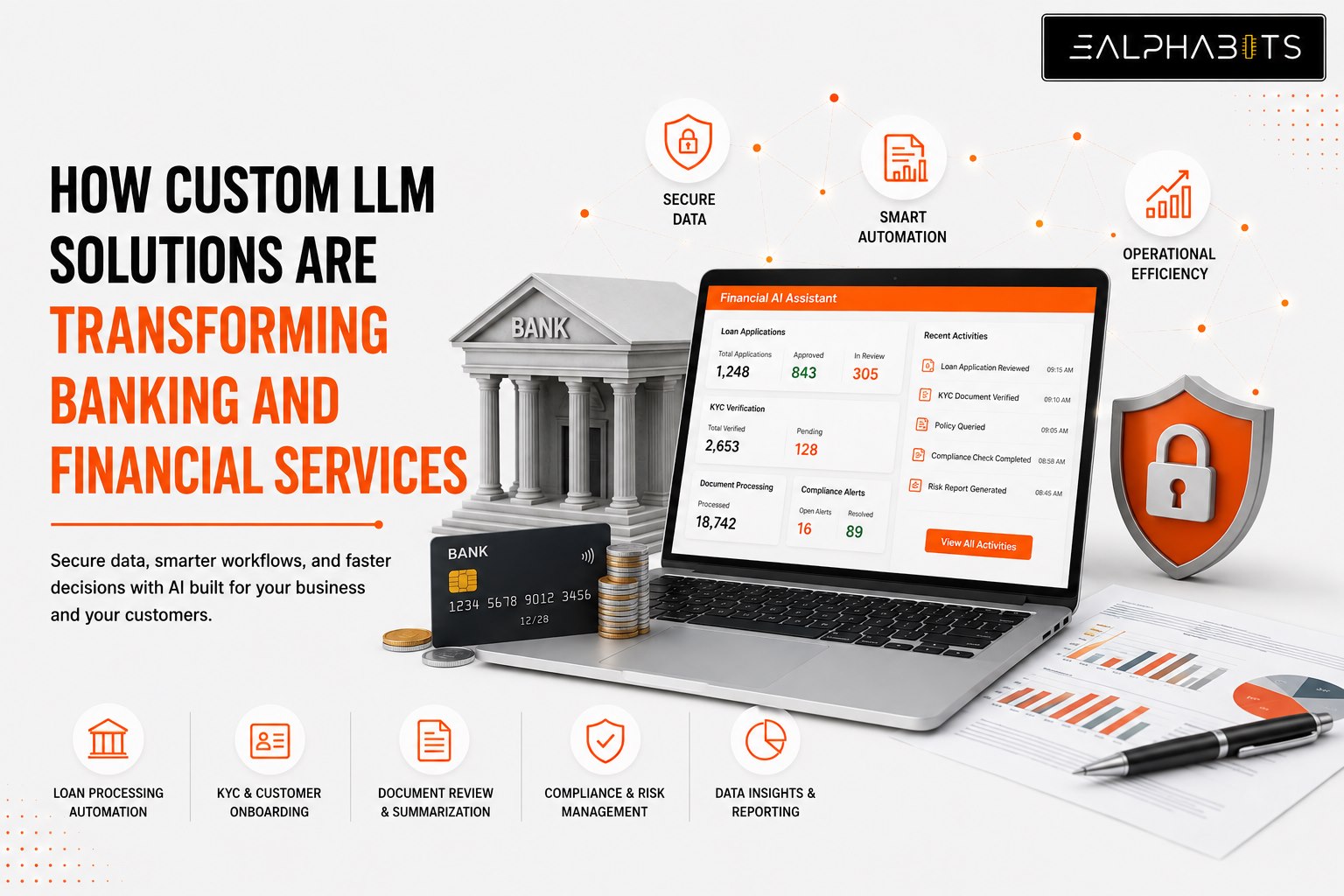
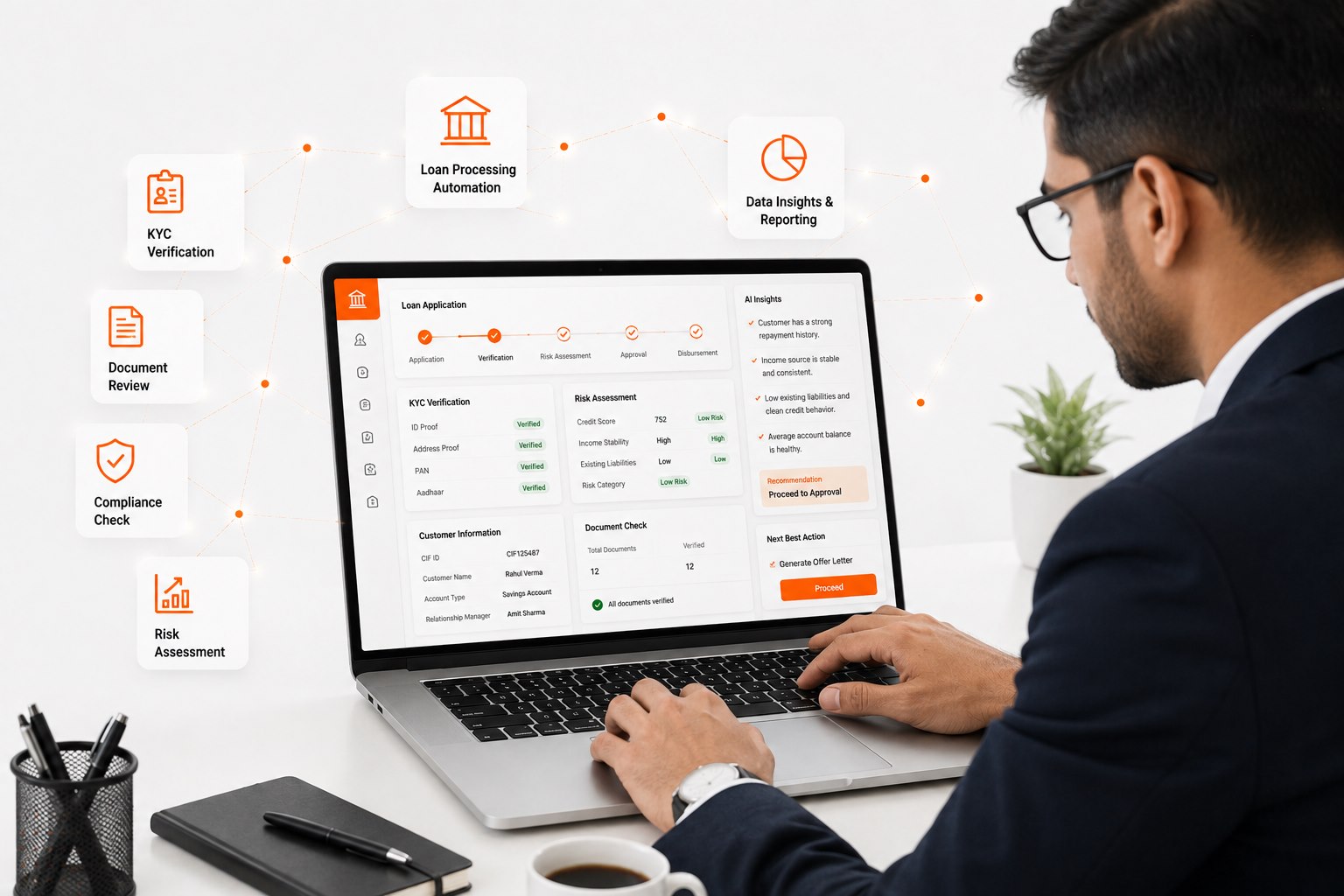
Automating Loan Processing and Document Review
Loan processing involves reviewing large amounts of information.
Applications may contain financial documents, identification records, employment information, statements, and other supporting documentation.
Instead of employees manually reviewing every document from beginning to end, a Custom LLM can assist with document understanding and information extraction.
It can help summarize applications, retrieve relevant information, and organize important details for review.
The final lending decision can remain with the appropriate financial professionals while AI handles repetitive, information-intensive work.
This can help reduce processing time while allowing employees to focus on cases that require deeper evaluation.
Simplifying KYC and Customer Onboarding
Know Your Customer processes require financial institutions to collect and review customer information.
When onboarding volumes increase, employees can spend significant time checking documents and entering information into different systems.
A customized AI solution can assist with extracting relevant information from approved documents and organizing it for the appropriate workflow.
Employees can also use the system to retrieve customer-related information more efficiently when authorized.
This creates an opportunity to reduce repetitive administrative work while maintaining human oversight throughout the process.
Making Internal Banking Knowledge Easier to Access
One of the most useful applications of a Custom LLM is internal knowledge retrieval.
Banks have policies, standard operating procedures, product documentation, compliance guidelines, and internal instructions that employees may need regularly.
Instead of searching through multiple folders or asking another department for a document, an employee can interact with the organization’s AI system and ask a question in natural language.
For example:
- What is the current procedure for this type of customer request?
- What documents are required for this process?
- Summarize the latest internal guidelines.
- Find the relevant section of the policy document.
This can make organizational knowledge more accessible while reducing unnecessary communication between departments.
Managing Customer Records More Efficiently
Customer information can exist across multiple records and documents.
When an employee needs to understand a customer’s history, manually reviewing several documents can take time.
A Custom LLM can help retrieve relevant information from authorized sources and create a concise summary for the employee.
This can be useful for customer service, relationship management, and internal operations where employees need context before responding to a customer or reviewing a case.
Better access to information can also reduce the dependency on individual employees who may have gained knowledge of a particular customer’s history over time.
Why Data Security Matters in Financial AI
Financial institutions cannot treat data security as an afterthought.
Customer information and internal business data require controlled access and appropriate security measures.
A Custom LLM solution can be designed around the organization’s security requirements. Access can be structured according to roles and permissions so employees only access information they are authorized to use.
The architecture can also be planned around the organization’s data handling requirements and existing infrastructure.
Rather than sending sensitive business information into a generic AI environment, organizations can build an AI system around their own requirements and approved information sources.
Security depends on the complete implementation and governance of the system. A Custom LLM should therefore be developed with access control, data protection, and organizational policies in mind from the beginning.
Reducing the Hidden Cost of Generic AI Usage
The cost of AI is not always limited to the subscription price.
Organizations processing large amounts of information may also face increasing usage and token costs.
Consider a financial company where hundreds of employees use AI every day to summarize documents, search information, and process records. As usage grows, the amount of information processed by the AI also increases.
A customized solution can provide greater control over how AI is deployed across the organization.
Instead of every employee independently using different AI tools, the organization can create a centralized environment designed around its own workflows.
This can also make it easier for the organization to manage how AI is used and where it provides the most operational value.
Building an AI Library Around Your Organization
Every financial institution operates differently.
The documents it uses, the approval processes it follows, the information employees need, and the systems it already has may all be different.
That is why a Custom LLM should not simply be treated as another chatbot.
It can be designed as an intelligent library for the organization.
The library can contain approved business knowledge and connect with relevant workflows. Employees can search this knowledge using natural language and receive information based on the organization’s own resources.
As the organization evolves, the system can also be adapted to new requirements.
How E-Alphabits Helps Financial Institutions
E-Alphabits develops Custom LLM Solutions around the specific needs of an organization.
The approach focuses on using business information, documents, and workflows to create an AI environment that supports real operational requirements.
For financial organizations, this can include assistance with loan documentation, KYC workflows, customer record retrieval, policy searches, compliance information, document summarization, and other repetitive processes.
The solution can also be designed to work alongside existing business systems instead of requiring an organization to completely replace the software it already uses.
The broader E-Alphabits Enterprise AI approach focuses on transforming organizational knowledge into an intelligent resource that employees can search and use more efficiently. The same method is already at work in other regulated, document-heavy sectors — see how it applies to medical records and insurance claims.
Benefits of Custom LLM Solutions for Financial Services
A well-designed solution can provide several practical benefits.
Faster Information Retrieval
Employees can find relevant information without spending excessive time searching through documents.
Reduced Manual Work
Repetitive document review and information extraction can be supported through automation.
Better Knowledge Management
Important organizational knowledge becomes easier to access across departments.
Improved Operational Efficiency
Employees can spend more time on work that requires human judgment and less time on repetitive information handling.
Greater Control Over AI
Organizations can build an AI environment around their own requirements instead of relying entirely on multiple public AI platforms.
Better Scalability
As the organization grows, the AI platform can be expanded to support additional departments, workflows, and information sources.
The Future of AI in Banking and Financial Services
AI adoption in financial services is moving beyond simple chatbots and content generation.
The next stage is about connecting AI with the information and workflows that businesses already depend on.
For banks and financial institutions, this means creating systems that can understand organizational knowledge, retrieve information quickly, and assist employees with repetitive processes.
The most valuable AI solution will not necessarily be the one that generates the most impressive response. It will be the one that solves a real operational problem and fits naturally into the way an organization works.
Custom LLM Solutions provide a way for financial institutions to build that capability around their own requirements.
Conclusion
Banks and financial institutions already possess enormous amounts of valuable information. The challenge is making that information accessible and useful without creating additional manual work or unnecessary operational complexity.
Custom LLM Solutions can help transform this information into an intelligent resource that employees can search, understand, and use more efficiently.
From loan processing and KYC to customer records, compliance documentation, and internal knowledge retrieval, the technology can support many information-intensive financial workflows.
For organizations concerned about sensitive data and the growing cost of public AI usage, a customized approach can provide greater control over how AI is introduced into daily operations.
Frequently Asked Questions
Can different departments have different levels of access?
Yes. Access can be structured according to employee roles and organizational requirements. For example, a customer service employee may need access to customer information while a compliance employee may require access to regulatory documents and internal policies.
Can AI understand financial documents that contain different formats?
A properly designed system can be built to work with different types of business documents such as reports, forms, statements, and policy documents. The exact capabilities depend on the document formats, data sources, and implementation.
Does a Custom LLM replace employees in banking operations?
The primary purpose is to assist employees with repetitive, information-intensive work. Tasks such as searching documents, summarizing records, and organizing information can be supported by AI, while important financial decisions can continue to involve qualified professionals.
Can a financial institution update the AI when its policies change?
Yes. A Custom LLM environment can be designed so approved information sources can be updated as policies, procedures, and business requirements change. This helps employees work with current organizational information.
What should a bank consider before implementing a Custom LLM?
A financial institution should first identify the processes where employees spend the most time searching, reviewing, or organizing information. It should also consider data security, access control, existing systems, document quality, and how the AI will be monitored and maintained over time.
Can a Custom LLM help financial companies reduce AI costs?
It can provide greater control over AI usage by creating a centralized environment designed around specific business requirements. Cost savings will depend on the architecture, usage volume, existing systems, and the workflows being automated.
What makes a Custom LLM different from simply using ChatGPT or another public AI tool?
A public AI tool is designed for a broad range of users and general purposes. A Custom LLM can be built around an organization’s own approved information, workflow, access requirements, and business processes. This makes it more suitable for organizations that need AI to work within a specific operational environment. You can read the wider picture in What Is Enterprise AI?