Healthcare and insurance organizations handle enormous amounts of information every day. Medical records, patient histories, claim documents, policy information, disease codes, and supporting documents all need to be reviewed and organized before a claim or insurance process can move forward.
For many organizations, a large part of this work is still handled manually. Employees may need to open multiple documents, search through patient records, identify relevant medical information, and enter the required details into another system. When the volume of records increases, this process can take significant time and can also create opportunities for human error.
This is where Custom LLM Solutions for Healthcare can make a practical difference.
Instead of using a general AI tool that has no understanding of an organization’s internal processes, a custom solution can be designed around the documents, workflows, and information that a healthcare or insurance organization actually uses.
E-Alphabits helps organizations build Custom LLM Solutions that can retrieve information, summarize documents, identify relevant details, and automate repetitive processes while keeping the solution aligned with the organization’s workflow. This builds on the broader approach of using organization-specific documents and business knowledge as an intelligent resource rather than relying only on generic AI tools.
The Challenge of Managing Medical Records Manually
Medical records can contain years of information about a patient. A single case may involve consultation notes, test results, diagnoses, prescriptions, treatment history, claim documents, and other supporting records.
For an insurance company reviewing a claim, the challenge is not simply storing these documents. The important information needs to be found and understood.
Employees may have to search through records to identify the relevant disease or diagnosis code and connect that information with the patient’s claim. If the patient has a previous medical history that could be relevant to the current case, the employee may need to search older records as well. This creates several challenges, including:
- Time-consuming document review
- Repeated manual data entry
- Difficulty finding historical information
- Large volumes of unstructured documents
- Inconsistent information retrieval
- Higher administrative workload
- Longer claim processing times
A Custom LLM can help reduce this repetitive workload by allowing employees to search and interact with organizational information using natural language.
How Custom LLM Solutions Can Understand Medical Documents
A Custom LLM solution can be connected to approved organizational documents and structured information so employees can retrieve relevant information without manually opening every file.
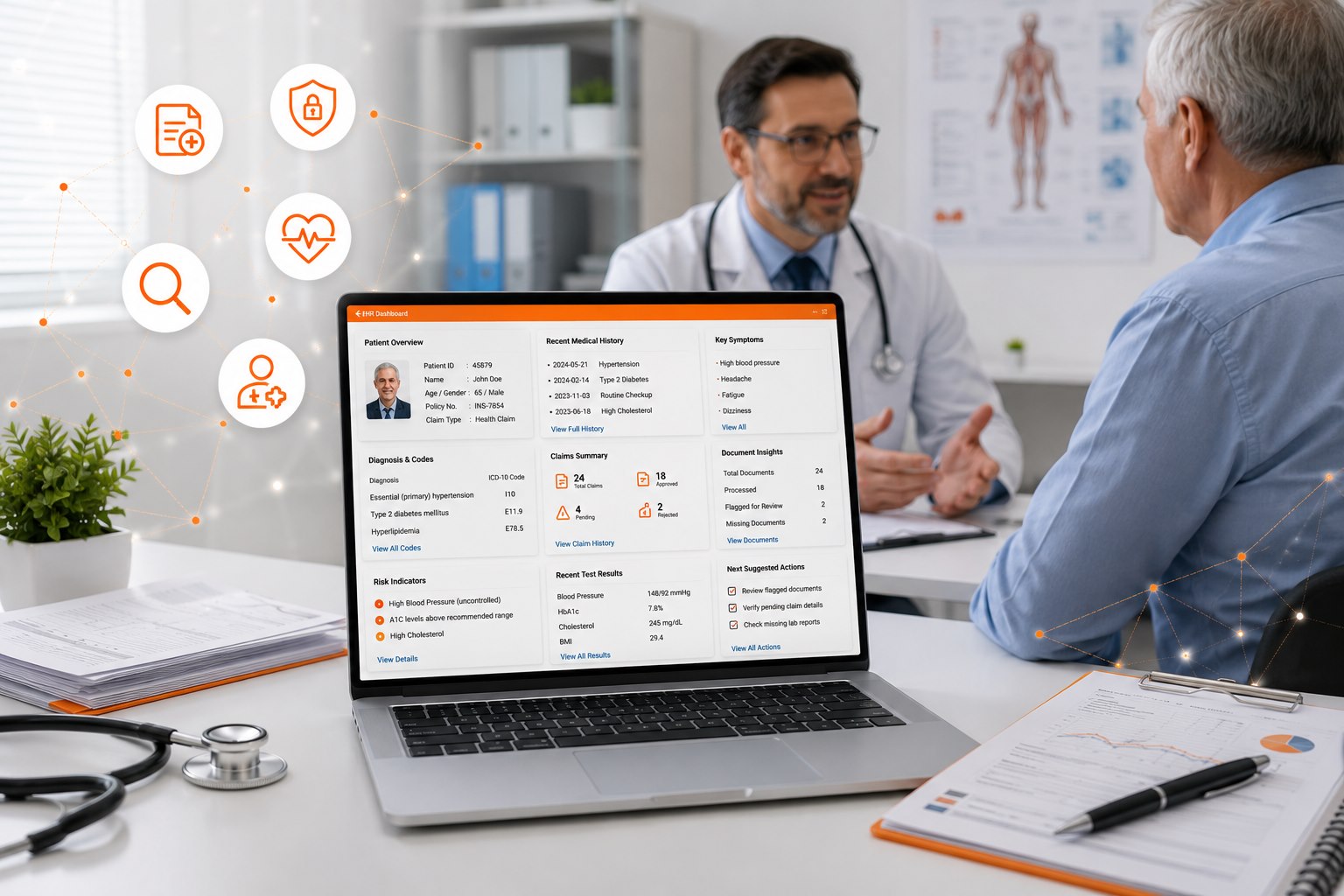
For example, an insurance employee reviewing a patient claim may need to understand the patient’s previous medical history before continuing the review.
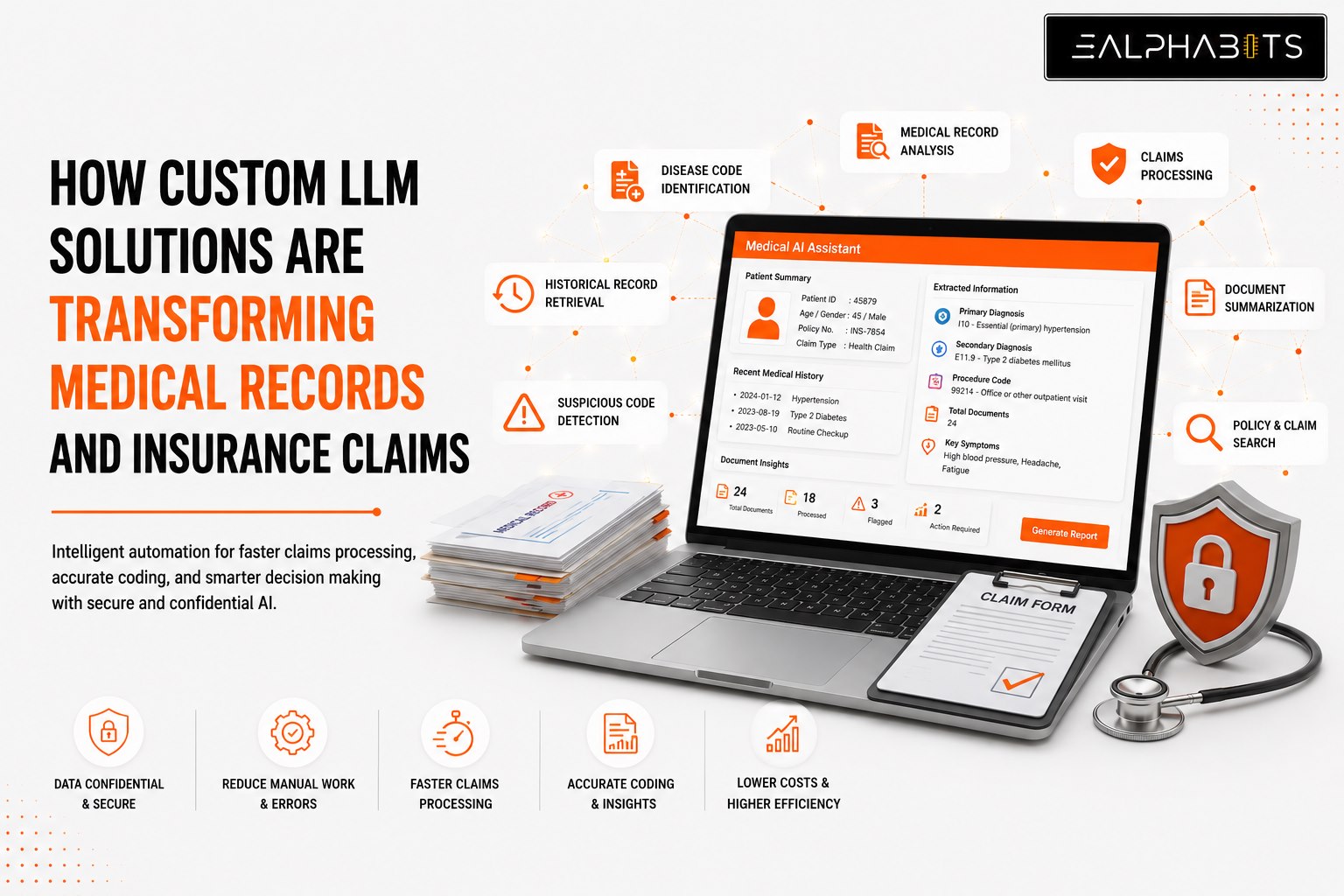
Instead of manually searching through multiple records, the employee could use the organization’s AI platform to retrieve relevant information and generate a concise summary.
- Previous diagnoses
- Relevant medical history
- Treatment information
- Medical documentation
- Disease or diagnosis codes
- Claim-related information
- Important dates
- Supporting documents
The purpose is not to replace medical professionals or make independent medical decisions. Instead, the system helps employees find and organize information that would otherwise require significant manual effort.
Automating Disease Code Identification
One of the practical use cases for AI in insurance operations is helping employees identify relevant disease or diagnosis codes from medical documentation.
Today, an employee may need to read through medical records, understand the documented condition, and then determine which code is relevant for the insurance workflow.
A Custom LLM can assist by analyzing the available documentation and identifying the medical information associated with relevant coding requirements.
This can reduce the amount of time employees spend searching through records.
The final review can still remain with the appropriate medical or insurance professional. The AI acts as an intelligent assistant that helps surface relevant information rather than replacing professional judgment.
Identifying Potentially Relevant Medical Indicators
Medical records can sometimes contain symptoms or information that may be relevant to future review.
A Custom LLM can help identify patterns or potentially relevant medical indicators within the information available to the organization. For example, the system may flag a combination of documented symptoms or historical information that deserves additional professional review.
Not a diagnosis — a second pair of eyes
Flagging a pattern is not the same as predicting that a patient will develop a condition. The value is in surfacing information that a large-scale manual review could easily miss, while clinical interpretation stays with qualified professionals.
Instead, the value comes from helping employees notice information that could otherwise be overlooked during a large-scale manual review.
This can create an additional layer of information support for insurance teams while keeping clinical interpretation with qualified professionals.
Connecting Current Claims With Historical Records
One of the biggest challenges in insurance operations is finding information that is spread across different records and documents.
An employee may have access to the current claim but also need information from previous claims or historical medical documentation.
A Custom LLM platform can make this information easier to retrieve by creating a searchable knowledge environment around approved organizational data.
Instead of remembering where a particular document was stored, employees can ask questions in natural language and retrieve relevant information from connected records.
This approach follows the broader principle behind Enterprise AI, where organizational knowledge becomes searchable rather than remaining scattered across folders, systems, and departments.
How AI Can Improve Insurance Claims Processing
Claims processing involves more than reviewing medical records.
Insurance teams also work with policy documents, claim histories, verification documents, customer records, and internal guidelines.
Custom LLM Solutions can assist with several parts of this workflow.
Claims Document Summarization
Long claim documents can be summarized so employees can quickly understand the important information before beginning a detailed review.
Policy Information Retrieval
Employees can search internal policy documents and retrieve relevant information without manually browsing through lengthy files.
Customer Record Retrieval
Relevant customer information can be found faster when records are organized within a searchable AI platform.
Document Verification Support
AI can help identify missing information, inconsistencies, or documents that may require additional attention.
Administrative Automation
Repeated tasks such as information extraction, document classification, and report generation can be automated to reduce employee workload.
These capabilities can help insurance companies spend less time on repetitive administrative work and more time on activities that require human judgment.
Why Public AI Tools May Not Be Enough for Medical Data
Many organizations begin using public AI tools because they are easy to access. Employees can upload a document, ask a question, and receive an answer within seconds.
However, medical and insurance organizations have different requirements.
Sensitive information needs to be handled according to the organization’s security and privacy requirements. Organizations also need greater control over where their information goes and how their AI system accesses it.
There is also the issue of usage-based costs.
When teams depend heavily on public AI platforms, token usage can increase as employees process more documents and generate more responses. For organizations handling thousands of records, this can become an ongoing operational expense.
A Custom LLM approach allows organizations to design an AI platform around their own workflows, data sources, access controls, and business requirements rather than relying entirely on a general-purpose AI service.
How E-Alphabits Custom LLM Solutions Help
E-Alphabits develops Custom LLM Solutions designed around the specific workflows of an organization.
Instead of providing a generic chatbot, the solution can be structured around organizational documents, processes, and knowledge.
For healthcare and insurance organizations, this can include medical documentation, claim-related information, internal policies, and administrative workflows.
The platform can help employees search information, summarize documents, retrieve historical records, and automate repetitive processes from one centralized environment.
The broader E-Alphabits Enterprise AI approach focuses on integrating AI with existing business processes rather than forcing organizations to replace the software systems they already use.
Benefits for Insurance Companies
When repetitive medical record and claims-related tasks are supported by AI, organizations can gain several operational benefits.
Faster Information Retrieval
Employees can find relevant information without spending large amounts of time searching through individual documents.
Reduced Manual Work
Routine document review and information extraction can be automated or assisted.
Better Record Organization
Information becomes easier to search and retrieve across large collections of documents.
Faster Claims Processing
Employees can access relevant information more quickly, which can help reduce unnecessary delays in the claims workflow.
Lower Operational Effort
Reducing repetitive administrative work allows teams to focus their time on cases that require deeper human review.
More Consistent Information Access
Employees can retrieve information through a centralized system rather than depending on individual knowledge of where records are stored.
The Future of Medical Enterprise AI
Healthcare and insurance organizations will continue generating larger volumes of digital information.
The challenge will not simply be storing that information. The bigger challenge will be making the right information available to the right employee at the right time.
Custom LLM Solutions can become an important part of this transition by turning large collections of documents and records into searchable organizational knowledge.
From medical record retrieval and disease code identification to claims processing and document automation, the technology can help organizations reduce repetitive work while improving access to information.
The most valuable healthcare AI systems will not simply generate answers. They will work within real organizational processes and support the professionals responsible for making important decisions.
Conclusion
Medical records and insurance claims contain valuable information, but finding and processing that information manually can consume significant time and resources.
Custom LLM Solutions for Healthcare provide a way to make this information easier to retrieve, understand, and organize.
For insurance companies, this can mean faster access to patient history, assistance with disease code identification, support for claims processing, and less time spent manually searching through records.
The goal is not to replace medical or insurance professionals. It is to give them an intelligent system that handles repetitive, information-intensive work so they can focus on decisions that require human expertise.
With E-Alphabits Custom LLM Solutions, organizations can move from scattered medical and insurance information toward a more intelligent, searchable, and efficient workflow while designing the system around their own operational requirements.
Frequently Asked Questions
Can AI work with different types of medical documents?
Yes. A properly designed AI system can work with different document formats and information sources such as medical reports, claim documents, policy documents, clinical notes, and historical records.
How can AI help when a patient has years of medical history?
AI can make large historical records easier to search and summarize. Instead of manually reviewing every previous document, an authorized employee can ask for specific information and receive relevant results from the available records.
Can a Custom LLM be connected to an insurance company’s existing systems?
Yes. A Custom LLM solution can be designed to work with an organization’s existing applications, databases, document repositories, and internal workflows where appropriate integrations are available. This allows AI to become part of the existing process rather than creating another isolated tool.
What is the difference between a healthcare chatbot and a Custom LLM solution?
A basic chatbot generally answers questions within a limited predefined workflow. A Custom LLM solution can be designed around an organization’s own approved knowledge, documents, workflows, permissions, and business processes. This makes it more suitable for complex internal operations where employees need access to organization-specific information.
Is a Custom LLM useful only for insurance companies?
No. The same approach can support hospitals, healthcare providers, diagnostic organizations, pharmaceutical companies, and other healthcare-related businesses. Possible applications include document search, administrative automation, internal knowledge retrieval, report summarization, and workflow assistance.
Why is data privacy especially important when using AI in healthcare?
Healthcare organizations handle highly sensitive information. Using AI therefore requires careful consideration of where data is processed, who can access it, how it is stored, and how the system is governed. A Custom LLM approach can be designed with an organization’s security and privacy requirements in mind rather than treating sensitive information like ordinary public data. You can read more about that approach in What Is Enterprise AI?