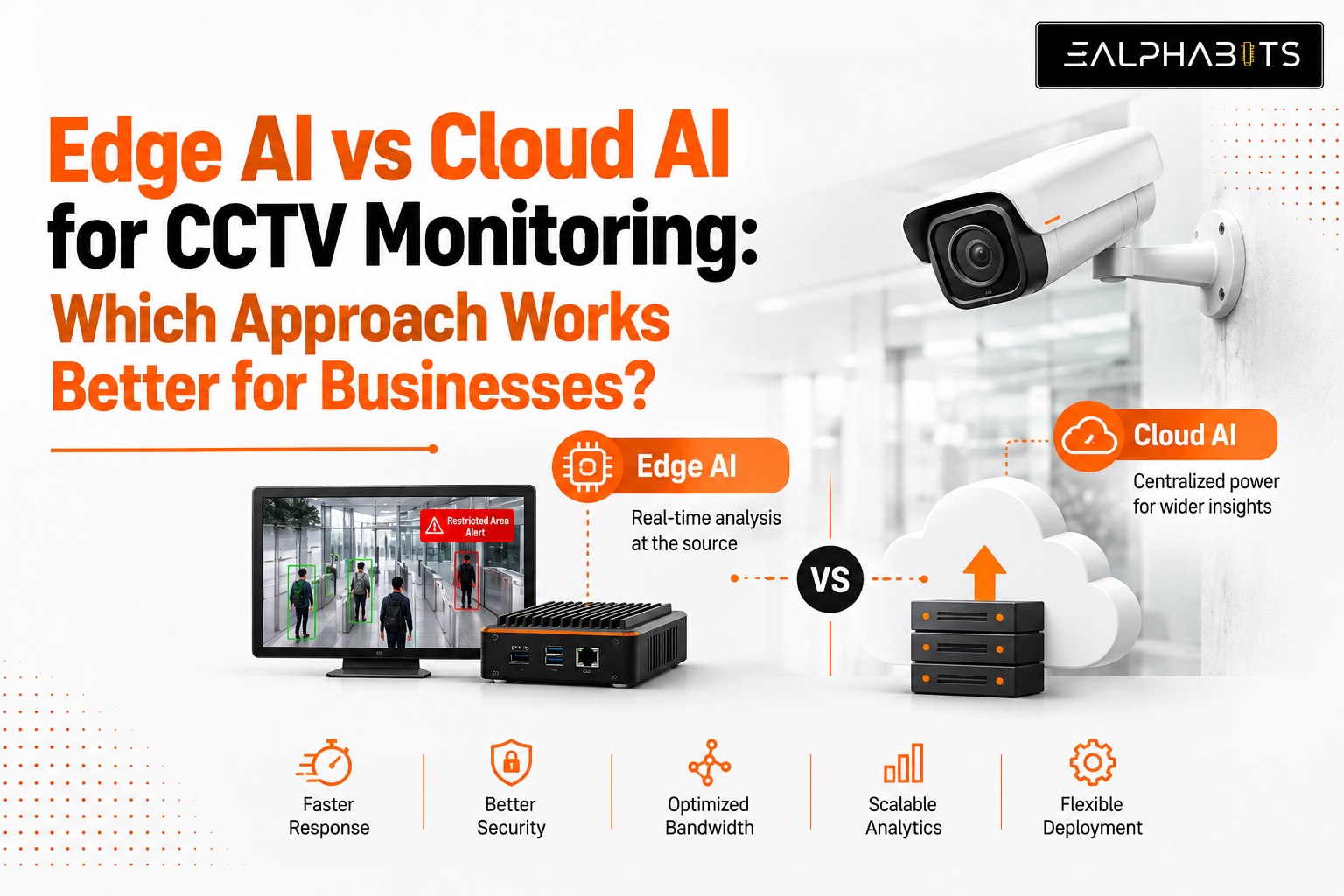
CCTV has traditionally been used to record what happens inside and around a business. When an incident occurs, security teams review the footage and try to understand what happened.
Camera AI changes this approach by allowing video feeds to be analyzed in real time. A system can detect events such as restricted zone entry, fire, falls, PPE violations, crowding, camera tampering and other predefined situations, then trigger an appropriate response.
But there is an important question when deploying Camera AI:
Should video processing happen at the edge, in the cloud, or through a combination of both?
The answer depends on the business environment, the number of cameras, network availability, privacy requirements, response time and the type of analytics required.
Both approaches have their place. Understanding the difference helps businesses choose an architecture that fits their actual operational needs rather than simply choosing the most popular technology.
What Is Edge AI for CCTV Monitoring?
Edge AI processes video data close to where it is generated. In a surveillance environment, this usually means an edge device installed at the business location receives camera feeds and performs the required analysis locally.
Instead of continuously sending raw video to a remote server, the system can analyze the footage on site and generate an event when something important is detected.
For example, if Camera AI is configured to detect a person entering a restricted area, the edge system can process the camera feed, identify the event and trigger an alert — without that video ever needing to make a round trip to a data centre.
E-Alphabits uses an edge-first approach for many Camera AI deployments, with processing available on devices such as NVIDIA Jetson-based hardware.
What Is Cloud AI for CCTV Monitoring?
Cloud AI processes video or relevant data using computing infrastructure hosted remotely. Camera feeds or selected information can be sent to cloud infrastructure where analytics, storage, dashboards or additional processing can take place.
Cloud architecture can be useful when a business operates across multiple locations and wants centralized visibility. For example, a company with branches in several cities may want to bring analytics from different locations into one central dashboard.
Cloud infrastructure can also provide access to substantial computing resources when more complex processing is required.
However, continuously transferring high volumes of video can increase bandwidth requirements and may introduce additional latency depending on the network connection.
Edge AI vs Cloud AI: The Key Difference
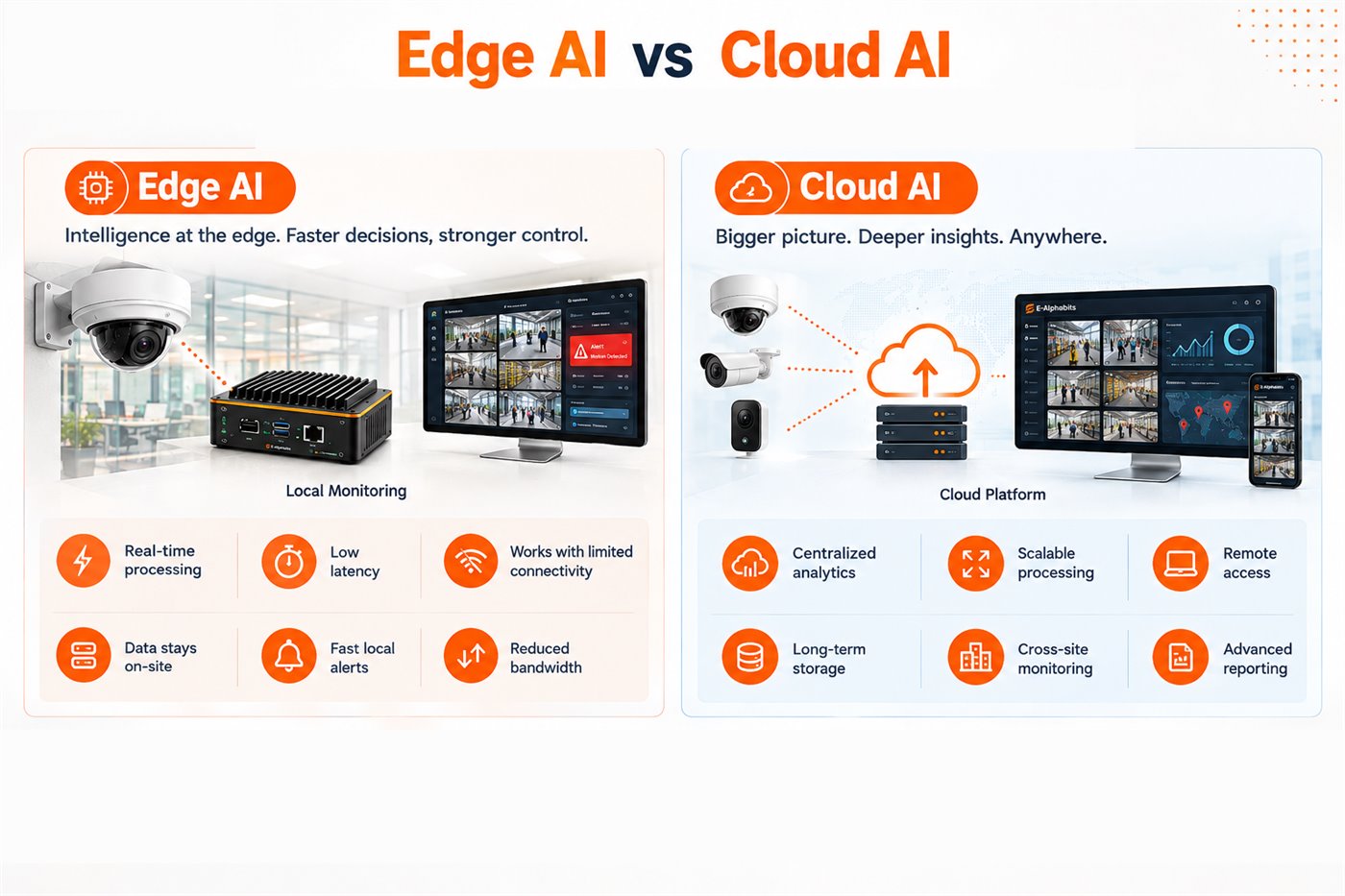
The simplest way to understand the difference is to look at where the video is processed. With edge processing, the analysis happens closer to the camera. With cloud processing, the data travels to remote computing infrastructure before the analysis takes place. A hybrid architecture combines both.
Edge AI
Analysis at the source
- Real-time processing on site
- Low latency, fast local alerts
- Works with limited connectivity
- Video can stay on-site
- Reduced bandwidth usage
Cloud AI
Analysis at the centre
- Centralized analytics
- Scalable processing capacity
- Remote access from anywhere
- Long-term storage
- Cross-site monitoring and reporting
E-Alphabits supports all three approaches through its Camera AI architecture: fully on-device processing, cloud processing and hybrid orchestration.
Why Processing Speed Matters
For many surveillance applications, response time is important. Imagine a Camera AI system detecting a person entering a restricted industrial area.
If the event can be analyzed locally, the system does not need to wait for the entire video stream to travel to a remote server and return with a result.
Latency, in practice
E-Alphabits reports on-device latency of less than 80 milliseconds for its edge architecture, while its cloud burst architecture is listed at less than 1.5 seconds under its stated deployment conditions.
This difference can matter for applications where every second counts. Examples include:
- Fire and smoke detection
- Restricted zone violations
- Fall detection
- Camera tampering
- Workplace safety
- Intrusion detection
For less time-sensitive applications such as centralized reporting and historical analytics, cloud processing may be perfectly suitable.
Bandwidth and Network Considerations
Video generates a large amount of data. A business with dozens or hundreds of cameras can create a significant network load if every video stream is continuously uploaded to the cloud.
Edge processing can reduce this requirement because the system can analyze the video locally and send only relevant information or event metadata to a central platform.
E-Alphabits states that metadata-only transmission can reduce bandwidth usage by approximately 98 percent compared with raw video upload in its architecture.
This can be particularly useful for factories, warehouses, remote facilities and large campuses where network bandwidth may be limited or expensive — the same economics that let Camera AI reduce the running cost of security.
Data Privacy and Security
Privacy is another important consideration. Businesses may not want continuous video from their premises leaving the local network.
With edge processing, video can remain within the organization’s network unless the business specifically chooses to send selected information to cloud infrastructure. This can be valuable for environments such as banks, hospitals, manufacturing facilities, government facilities, research centers and corporate offices.
E-Alphabits describes its edge approach as keeping video on the organization’s network unless cloud processing is enabled. Its edge devices also support security measures such as secure boot, encrypted firmware, TLS communication and role-based access.
The exact security architecture should always be designed according to the organization’s requirements and deployment environment.
Existing CCTV Can Work With Camera AI
One of the biggest advantages of a properly designed Camera AI system is that businesses may not need to replace their entire CCTV infrastructure.
No camera replacement required
E-Alphabits supports existing IP cameras through RTSP and ONVIF, and can also work with compatible analog systems through DVR or NVR bridges. See Adding AI to Existing CCTV for how that layer is added.
This means an organization can potentially build intelligence around the cameras it already owns. The camera becomes the source of visual information, while the edge device, cloud platform or hybrid architecture provides the intelligence and response layer.
This is particularly useful for organizations that have already invested significantly in surveillance infrastructure.
What Can Camera AI Detect?
The architecture can support a wide range of use cases depending on the deployment and the models selected.
Security
- Intrusion detection
- Restricted area monitoring
- Theft detection
- Camera tampering
- After-hours activity
Workplace safety
- Helmet detection
- PPE compliance
- Fall detection
- Person and machine presence
- Lockout tagout monitoring
Fire & emergency
- Fire detection
- Smoke detection
- Emergency situations
Retail
- Footfall analytics
- Queue monitoring
- Dwell analysis
- Customer movement
Education
- Attendance
- Student engagement
- Campus security
- Crowd monitoring
Healthcare
- Patient fall detection
- Restricted area monitoring
- Queue management
The value of Camera AI comes from choosing the right use cases for the environment rather than simply adding every available detection model. For schools and campuses this is packaged as Campus AI; for factories, warehouses and offices it is Workplace AI.
Why E-Alphabits Uses an Edge-First Approach
E-Alphabits focuses on building Camera AI systems for real-world environments rather than limiting solutions to controlled demonstrations. Its architecture allows businesses to choose between edge, cloud and hybrid processing based on the application.
The company works across Camera AI, embedded systems, computer vision and AI engineering, allowing the processing architecture to be designed alongside the actual use case.
This is important because surveillance requirements vary significantly between a retail store, manufacturing plant, hospital, bank and warehouse. A solution should be designed around the environment rather than forcing every business into the same architecture.
Edge AI vs Cloud AI: Which One Is Better?
Choose edge processing when:
- You need very fast response
Safety and security events where a delay of seconds changes the outcome. - Network connectivity is limited
Remote sites, factories and campuses where uplink is slow, capped or unreliable. - Video privacy is important
Footage stays on the organization’s own network unless you choose otherwise. - You want to reduce continuous video transmission
Send event metadata instead of streaming every camera around the clock. - You need local operation
Core analysis keeps running even when the internet connection drops.
Choose cloud processing when:
- You need centralized analytics
One view across every camera and every site. - You manage multiple locations
Branches in different cities reporting into a single dashboard. - You require large-scale data processing
Heavier models and historical analysis that benefit from elastic compute. - Centralized reporting is a priority
Long-term storage, trends and cross-site comparison over time.
E-Alphabits supports alerts through WhatsApp, SMS, email, dashboards, sirens and third-party systems depending on the deployment.
Conclusion
The debate between Edge AI and Cloud AI is not really about choosing which technology is universally better. It is about choosing the right architecture for the problem.
Edge processing brings intelligence closer to the camera, helping businesses achieve faster response, lower bandwidth usage and greater control over where video is processed. Cloud processing provides centralized computing, analytics and visibility across locations. Hybrid architecture brings these strengths together.
For businesses looking at vision tech solutions, the right approach should begin with the actual operational requirement. Whether the goal is safety monitoring, security, retail analytics, healthcare monitoring or industrial compliance, the architecture should support the way the business operates. If you are new to how the analysis itself works, How Camera with AI Works walks through it step by step.
E-Alphabits approaches Camera AI with this flexibility, helping organizations turn existing CCTV infrastructure into intelligent systems that can detect, analyze and respond in real time. For businesses looking for a camera AI solution company in Ahmedabad, this edge-first and hybrid-capable approach provides a foundation for deploying Camera AI according to the needs of the environment rather than relying on a one-size-fits-all model.
Frequently Asked Questions
Can businesses use Camera AI without replacing their existing CCTV infrastructure?
Yes. Camera AI can often be integrated with existing IP cameras and compatible CCTV systems. Adding AI to Existing CCTV covers what that involves.
What happens if the internet connection goes down during surveillance?
With an edge-first setup, core video analysis can continue locally because processing does not depend entirely on a cloud connection.
Can Camera AI work with cameras from different manufacturers?
It can, provided the cameras support compatible video-streaming standards. E-Alphabits, for example, supports RTSP and ONVIF-compliant IP cameras and can also work with many analog cameras through DVR/NVR bridges.
How does Camera AI affect CCTV data privacy?
Local processing can reduce the need to transfer raw video outside the organization’s network. This can provide greater control over sensitive footage, particularly in certain environments.
Can new detection use cases be added after deployment?
Yes, depending on the Camera AI platform and available models. Businesses can begin with a few priority use cases and expand the system as their requirements grow. E-Alphabits states that clients can add new use cases after deployment.